Black_Friday_episode_transcript
Catherine Edley [00:00:00]:
In today’s episode, we’re going to be talking about what Black Friday really means for small businesses in 2025. Whether it’s worth your time and energy and if you do take part, how to run promotions that protect your profit margins and play to your strengths rather than just getting lost in all of the noise. Welcome to the Resilient Retail Game Plan. I’m Catherine Edley and in the next few minutes, you’re about to get powerful real world retail strategies from insights shared both from my guests and myself, backed up by my 25 years in the retail industry. Keep listening to learn how to grow a thriving, profitable product business. Let’s jump in with this latest episode. Black Friday 2024 smashed records in the UK with consumers spending over 1.12 billion online in a single day. And across Black Friday to Cyber Monday weekend, that number climbed to 3.63 billion.
Catherine Edley [00:00:58]:
That’s a 5% increase from the year before, even in the middle of a cost of living crisis. So this is a major shopping event. The question is, how much of it can you capture as a small product business? Because let’s be honest, Black Friday can feel like a double edged sword. On the one hand, it’s the biggest shopping event of the year. On the other hand, it’s dominated by big retailers with deep pockets, aggressive discounts and marketing budgets that you just simply aren’t going to be able to match. So that’s exactly what we’re going to delve into. So Black Friday, let’s put it all into context in 2025, that is coming on the 28th of November. But as anyone who has been in the retail industry for a while will know, and in fact, anyone who does any shopping will know it’s no longer one day.
Catherine Edley [00:01:50]:
It is something that has crept forward bit by bit to the point where some of the big giants like Amazon, they start in, in late October and people talk about Black Friday month and all of this kind of thing. So it’s gone from being a single day to really expanding to be a full month. And Black Friday, it’s a U.S. holiday. It started in the U.S. it is the day after Thanksgiving. So a lot of Thanksgiving is the final Thursday of the month of November. And typically businesses would close or some businesses would give their employees the Friday off as well so that they could travel and see family.
Catherine Edley [00:02:33]:
And therefore it was a day that a lot of people had time off. And also the other thing that happens in the US with Thanksgiving being such a key holiday, it tends to slightly push back the onset of Christmas, or at least it used to. So for example, in the uk, pretty much as soon as we’ve done with bonfire night on the 5th of November, we’re straight into Christmas. In the US because Thanksgiving is coming at the end of the month, it tends to be that it switches over people’s mentality switches to their Christmas shopping post Thanksgiving. So Thanksgiving is predominantly a food related holiday, spending time with family. It’s not something that you buy presents for. So people would really start thinking about their Christmas shopping the day after Thanksgiving. And that’s where it started.
Catherine Edley [00:03:20]:
And there are lots of different theories as to why it’s called Black Friday, but one of them is that that is the day that the retailers went into the black. They’d been running in a deficit for the entire year, but once the Christmas shopping kicked in, they would actually turn a profit. Hence the name Black Friday. And in the us it also has different connotations. A lot of the really big stores would be doing what they call door buster deals, where if you’re one of the first people in through the door, you get these incredible discounts. And it’s generally seen as a big shopping day. And in the uk, it’s come over here completely detached from Thanksgiving because of course we don’t celebrate Thanksgiving in the U in the uk. And so we just have it really as this discounting.
Catherine Edley [00:04:04]:
And what it’s actually meant to the retail industry overall is that we, what it’s done is effectively pulled some of that Christmas spending out of December and into November. So for many, many years in the retail industry, we would always see December as the biggest year, biggest month of the year, because that was where all the Christmas spending happened. But what we, what I saw in the companies that I worked for was with the advent of all of this discounting in November, what was happening was it, it was actually not increasing spend overall for that Christmas period, but it was effectively pulling it forward a month. So for some people November is their biggest month. Some people it’s still December, but it has really changed and shifted the way that people spend their money during this Christmas time period. And I, the reason I’m, I say all of this is because I think it’s really important as small business owners that you understand the kind of big picture of Black Friday, what’s actually happening during that time, and then make the decision that is best for you because I do think there are opportunities in Black Friday. In the small business world, Black Friday can feel like a really, really loaded topic. Some people absolutely will not even Entertain doing anything for it.
Catherine Edley [00:05:19]:
And sometimes I’ve even seen people talking out against small businesses that take part. But I honestly think it’s a personal choice. I think that Black Friday as it exists in terms of really super deep discounting, that’s not really a game for small businesses to play because they just don’t generally have the mar. But that said, we are talking about what’s on your customer’s mind and your customer is going to be thinking about their Christmas purchasing around Black Friday. So it makes sense for you as a business owner to be thinking about what you can do that is right for you and for your business. And that’s really what I want to delve into in this episode is about you thinking about what you want it to look like for your business and the way that you can use it to make the to have the the best situation for you as a business owner. So should you participate in Black Friday? Well, let’s look at some pros and cons. The pros are, as I mentioned before, this is the shopping event of the year.
Catherine Edley [00:06:21]:
For many businesses, this will be the point in which they take the most money. So having some kind of offer can help boost your visibility during the biggest shopping event of the year and help you acquire new customers. Because ultimately that’s the name of the game, acquiring new customers and getting your loyal customers to come back more often. It can also be a great opportunity on that note to reward and engage your loyal customers. And it can actually be fun. There are lots of different ways that you can make it creative and interesting as well as as try and catch the wave. So sometimes I think about with discounts, for example, if you are going to try and make the most out of your discounts, then it can work well to do them when are already buying because it’s almost like you’re catching that wave. Like if you’re surfing and you the wave of people spending, can you catch that and then amplify the impact of what you’re doing? And so why, why should you not take part in Black Friday? You may just fundamentally disagree with it and that’s absolutely fine.
Catherine Edley [00:07:21]:
If it feels really wrong for you to do something for Black Friday for your business, then you absolutely can opt out. There’s lots of other options as well. People like just a card campaign often do their indie week alternative to Black Friday. There is of course Small Business Saturday, which is an absolutely fantastic opportunity to shout about being a small business. And that happens on Saturday 29th November, for example. So shortly after Black Friday. And that is something that can be a really good way for you to align. Some people just don’t want the additional stress.
Catherine Edley [00:07:58]:
If your sales have been really, really good, you may just not want to participate in Black Friday because you know it’s going to cause a peak of sales that you’re just not really prepared to staff up to that peak. It can cause some, some risks in terms of planning your stock. How do you plan it? Making sure that you’ve got enough stock to support it, for example, and you may just not have the margin for it. You may not want to have any kind of discount going on. And ultimately, if you know that you can hit your sales targets without doing anything specific for Black Friday and you don’t want the impact on your margins and you don’t want the kind of stress of having a big spike of sales, then by all means don’t feel like you have to participate. It’s not all or nothing either. You can choose your own version of Black Friday which aligns with your brand values and your bottom line. You don’t have to get caught up in the idea that it all has to be about discounts.
Catherine Edley [00:08:50]:
For example, you can have. There are lots of different options which we’re going to delve into. The other thing that I would really encourage you to do when it comes to Black Friday is we’re going to talk a little bit more in the podcast about what some different options are, how you can, how you can choose different types of promotions. But the other thing that I’d really stress is that Black Friday doesn’t exist in a vacuum. One of the most effective ways to plan your Black Friday and the reason that I’m releasing this podcast episode now and not even closer to the time is that really realistically you need to think about the entire 13 week time period in the run up to Christmas. So the fourth quarter from the beginning of October all the way through to the end of December. Look at that, look at that time period. Because what you want to do is you want to really plan your Black Friday as part of a broader Q4 strategy.
Catherine Edley [00:09:45]:
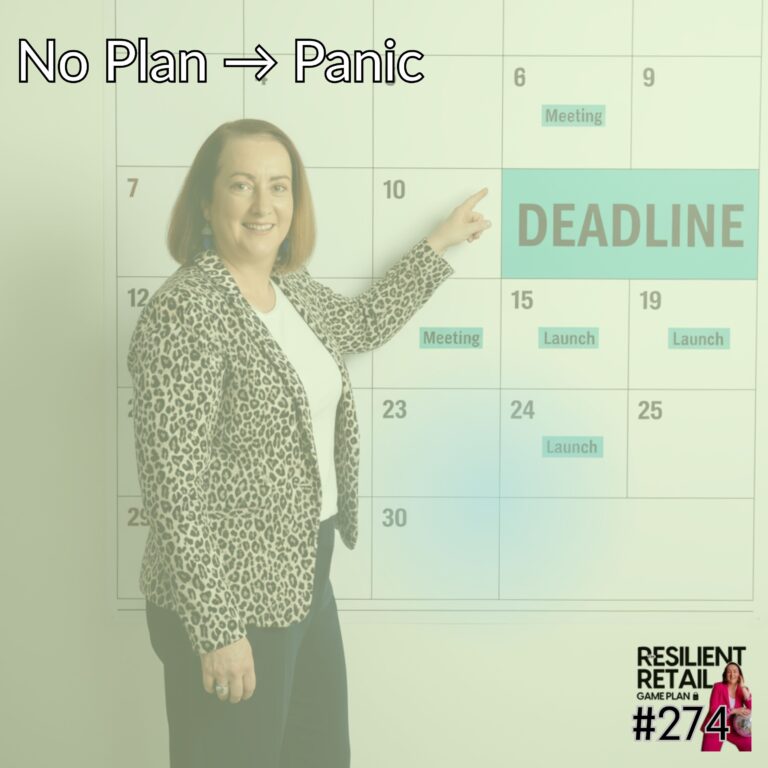
And what I mean by that is don’t have small discounts and small offers and all the way through and as well as big offer on Black Friday. If you’re going to do something big for Black Friday, you may well want to really focus on your full price sales the rest of the time. What you don’t want to do is feel like you’re offering discounts or giveaways or. Sorry, let me say that Again, what you don’t want to do is feel like you’re offering lots of different promotions that all get mixed up and then Black Friday doesn’t really stand out. For example, if you did want to do something discount related, you really want it to be the main discount that you do in that fourth quarter to make it special, to make it really have impact and to really reduce the promotional fatigue that can happen when you just run repeated discounts. So how do you plan it out then? So as I said, look at the entire fourth quarter, look at that 13 week time period, work out what you’re going to be talking about, various different points. Anyway, if you are in the resilient retail club or you work with me one to one, you’ll know I’m a big fan of something called the trading calendar, which really helps you map out what are your product launches, what are your business events that are happening anyway, what are all of the different things that you’re doing in that fourth quarter that you need to take into account so that you don’t end up with too many mixed messages. So work out what you’ve got going on each week and then work out, okay, so what is the message that you want for Black Friday? And one of the ways that you can look at it is you can ask yourself, what am I actually trying to achieve in Black Friday? And here are some different goals that you might have.
Catherine Edley [00:11:27]:
You might have the simple goal of sales and profit. Okay? So that’s absolutely fine. It’s really, in that case just about driving as many sales as you can without being brand damaging. In that case, you would want to focus on a discount. I am not a fan of blanket discounts, as I’ve said many, many times. In other words, money off absolutely everything. But if you ever were going to do one, then Black Friday can work really, really well. Especially if it’s a tactic that you don’t use very often or rarely or ever.
Catherine Edley [00:11:59]:
Then it can work well to say, right, well, for one day, two days, maybe the four, the full four day time period, I’m going to offer money off everything. And that is it. That is what you’re going to do and that is what you’re going to promote. And that works especially well. As I said, that’s another reason to look at the entire fourth quarter. Because if you’re always running these kinds of offers, then it’s not going to have much impact on Black Friday. All you’re going to have to do is go deeper than you normally do, which is a very Slippery slope. So what you’re going to want to do is if you are going to decide that that’s the thing you’re going to aim for with that blanket discount you want to really focus in on, okay, this is the message for the whole fourth quarter.
Catherine Edley [00:12:40]:
And I’m not going to do other things that might dilute from it. You might also have an eye, a goal of customer acquisition. So that could be another reason to do the blanket money off people that you know are on your list who haven’t bought. For example, you might do an offer just for them. You just want people to move from being people who are interested in your brand to people who buy. And another option you might have is you might decide, well, actually what I really want for Black Friday is I want to clear some unproductive stock. And personally this is one of my favorite kinds of Black Friday promotions because you can make them look quite enticing to your customer, but they can also help really move you through some slow moving stock. And the way that you would do that is you would identify what was moving slowly and then you would put together a, a promotion that is off selected lines.
Catherine Edley [00:13:30]:
So it could be a, you know, decent discount. It could be 25, 30% off your selected lines if you’re effectively using your discount to shape your customer behavior to clear through some unproductive stock. So those would be some different types of goals for you to think about for your Black Friday promotion. And there’s lots of other things that you can do as well. So we talked there about the discounts, but there’s other things that you might want to do. Feeling overwhelmed, stuck in reaction mode and tired of winging it. Retail by Design is my six month one to one program for six figure product founders who are ready for clarity, strategy and proper support. Using my signature focused framework, we turn scattered businesses into calm, profitable ones with hands on help to sort your structure, cash flow and sales.
Catherine Edley [00:14:20]:
If you’re ready to feel confident and in control Again, head to resilientretailclub.com and click on Retail by Design to book a call. So we talked there about the discounts, but there’s other things that you might want to do. Something you might offer for Black Friday would be an exclusive bundle or an exclusive product. In fact, exclusive products can work quite well. If you really want to push a full price agenda at Black Friday and not go for discounting. One of the ways you can get people to actually part with their money at a very discount driven time of year is by offering them something new and exclusive that they can’t get at other times. So bundles are also great options. So you could, for example, put together bundles of your products and either you’re just offering them at a slight discount or slightly better price than you would get if you bought them all separately, or you might offer some kind of other upgrade like free gift wrapping or free box or basket or whatever it is that your products are presented in.
Catherine Edley [00:15:16]:
You can also offer other things like loyalty rewards or enhanced loyalty rewards if you have a loyalty scheme. I definitely would suggest that whatever you do, whatever you choose to do as your promotion, always think about giving your VIP earning early access or just asking yourself for every single promotion that you do, what are you offering your VIPs also known as your either just all of your email subscribers or your very best email subscribers. So make sure that you are thinking about whatever it is that you’re doing that you’re using it also to help drive sign up and engagement with your email list because they’re getting either additional acts, special perks or they’re getting early access or they’re getting extensions on the discount. So for example, they get an early Black Friday preview on a Thursday, everybody else gets it on the Friday. Those those types of tactics, they help give you that double whammy from the promotion that you’re not only hyping the promotion, but you’re also encouraging people to want to become a vip, want to become part of your inner community, as it were. With all of these, you can pick and choose. You may decide that your Black Friday offer is going to be that you have a special gift with purchase that is only going to be shipping out on Black Friday. That might be what you choose to do and that might align really well with your business, really focusing on your business ethos, your values.
Catherine Edley [00:16:44]:
And it works really well because you know that your customers love special perks and special and limited edition items. You might decide that Black Friday is going to be the one time of the year you do a blanket discount and really go out all out and push it. Those are two different ends of the spectrum. And as I said, I really do believe that for small businesses it’s up to you to decide where you sit. But what I would suggest is that you decide it as part of your fourth quarter overall plan and that you really think about whatever it is that you’re offering, that you make sure that you are giving your VIPs and your email subscribers an additional boost as well. So as I said, it could be that they get an extra special gift or a different gift or an additional gift. It could be that they get the gift for longer or get the opportunity to get the gift for longer. But the main thing is that you really choose something that aligns.
Catherine Edley [00:17:36]:
But choose it, set it, think about it. Now, don’t leave it to the last minute. Don’t leave it to the point at which all of the marketing messages start firing out and you start feeling really worried that you’ve somehow missed the boat. And don’t forget, you can build anticipation early. You can have teasers. I would also suggest that if you listen to all of this and you think, well, I actually think my stock is fine, I don’t really, I don’t really see the point of doing anything additional for Black Friday if you’re not going to participate. I would recommend that you actually tell your customers that the reason for that is that almost everybody sees a wavering in sales in that week of Black Friday. Because Black Friday, why would you buy something at full price as a customer? Why would you buy something full price on a Tuesday if you know Black Friday is coming on the Friday? And it may not be that you are going to insist on there being a discount, but you just know that if you wait another three or four days, you’re going to find out if there’s a discount or some kind of perk.
Catherine Edley [00:18:34]:
So if there isn’t going to be one, then it’s absolutely fine to say that to your customers. And it’s absolutely fine to make that point. And you know, why not explain why if there’s a reason that you’re not taking part? I think that can also be an opportunity to really build customer loyalty, brand loyalty. I think that it’s a really great opportunity for you to be really clear about what you stand for as a business and also take a look for everyone who’s doing Black Friday in an alternative way. I think it’s really nice to see. I often cite Lucy and Yak as an example of people who do a really great purpose led version of Black Friday where effectively what they do is that they do charitable donations based on the sales on Black Friday and they send girls to school in India and they talk about the number of pupils that they’ve been able to support so far and they keep updating it through the weekend. So it’s very engaging. It’s something that the customers can really get behind.
Catherine Edley [00:19:31]:
I mean, it’s absolutely nothing to do with discounts. It’s all to do with a charitable donation instead. So there’s lots of different things that you can do, you can tie it into charity. In the US I’ve seen people do, because it’s the same week as Thanksgiving. They’ve done a whole festival of being grateful and giving back to their customers, for example. And that’s something that I talked about in the loyalty episode of the podcast with Charlie Casey a couple of weeks ago. But there’s lots and lots of different options. The thing is, as I said, it can be creative, it can be fun.
Catherine Edley [00:20:07]:
Have a challenge yourself. Think of something fun and different that you could do. And that could still be doing a discount, but in a fun and interesting way. The only thing I will say as well is just make sure that your offers are really, really simple. If you are offering a discount, then just keep it really simple. The one thing I really dislike on Black Friday is when I go onto somebody’s website and they have things like they say, well, spend this much and get free shipping or get a free bracelet or get money off this, that and the other. And you just feel a bit overwhelmed. You want it to be really, really simple.
Catherine Edley [00:20:42]:
Either you’re offering money off or free shipping or whatever it might be, but just don’t try and stack too many different offers. Because I just think that the more complicated an offer, the less likely the customer is to engage with it. They don’t like things that are complicated. They just like it to be super simple. So we know we’ve talked today about how Black Friday 2025, it’s going to be bigger than ever. The spending figures from 2024, they prove just how much money flows through the world’s e commerce websites and shop tills in that particular weekend. And it can be tempting to think when you get surrounded by all of this promotional Black Friday messaging, that it has to be about discounts. But I really, truly, strongly believe that it doesn’t have to be about discounts.
Catherine Edley [00:21:26]:
You can do anything from nothing to charitable donations to special products. You can offer bundles, you can offer discounts, what we call bounce back where you offer them money off in January if they buy with you. In Black Friday, there’s so many different things that you can do. It’s well worth taking the time now to really think about Black Friday. Think about how it’s going to fit into everything else that you do in the business and come up with something that you can feel really proud about, that you can shout about and that can help you. You build loyalty and also springboard you into 2026 with lots of fabulous new customers. So if you’ve enjoyed today’s episode. Why not follow, subscribe or like the podcast, depending on the platform that you’re on? We’re going to be having lots more tips about selling at Christmas as we go through the next few months, so stay tuned to the podcast.
Catherine Edley [00:22:28]:
If you have not already subscribed, liked or followed the podcast, depending on the podcast platform you use, then please do so and you’ll be the first to know about each new episode, which comes out every Thursday morning. See you next week.
 Skip to content

 Why does this matter for you? If you’re approaching Black Friday as a one-off, last-minute scramble, you’ll end up fighting for scraps or simply adding stress. The trick is to:
 It’s a personal decision. Some brands opt out entirely, channelling their energies into alternatives like Indie Week or Small Business Saturday. Others find the stress and stock planning just isn’t worth it, especially when sales are already steady.