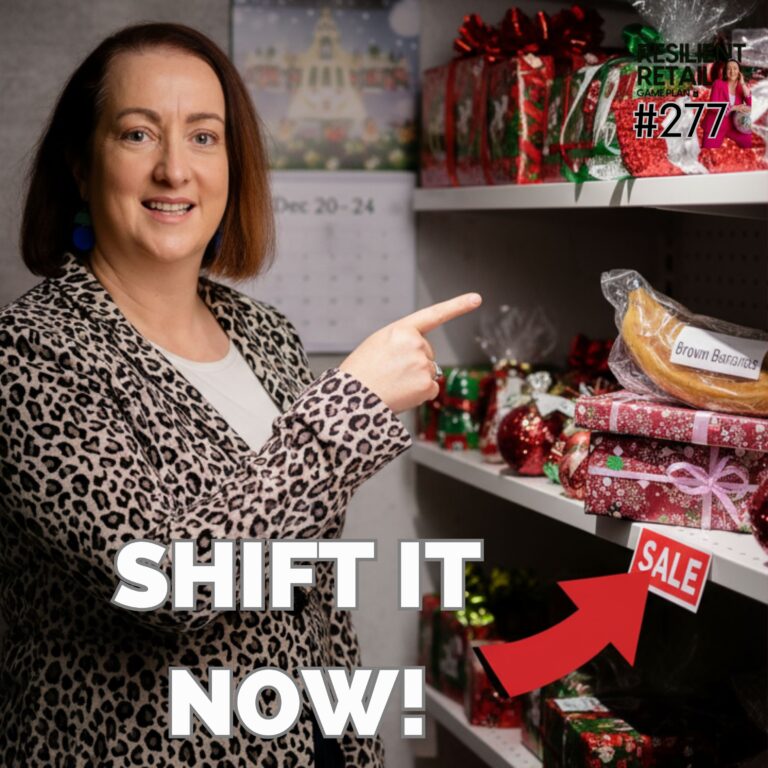
281 Running a stock clearance sale
281 Running a stock clearance sale
[00:00:00] Introduction to Strategic Stock Clearance
[00:00:00] Catherine: Today we’re talking about one of the most important tools in your retail toolkit, a well run stock
[00:00:05] sale, not a
[00:00:06] panic sale, not
[00:00:07] blanket discount, but a strategic cash
[00:00:09] releasing [00:00:10] moment that helps you start the year lighter and more profitable. I’ll walk you through exactly what to clear, how deep
[00:00:15] discount, and how to make your clearance event work for you rather than against your [00:00:20] margins.
[00:00:20] Let’s jump into
[00:00:21] into it now, if you want more information about stock management in your business, I’ve been talking about stock a lot in recent episodes. So for [00:00:30] example, you might wanna
[00:00:31] a look at
[00:00:32] episode 2 78, which is about how much money’s trapped in your stock room, or 2 77, where we talk a little bit more about slow sellers and [00:00:40] overstocks.
[00:00:40] But in today’s episode, I wanted to focus in on your stereotypical, as it were. January clearance sale. So if you’re listening to
[00:00:48] episode
[00:00:49] Timing Your Clearance Sale
[00:00:49] Catherine: on the day of [00:00:50] release, it is Thursday, the 18th of December, which means that we are one week out from Christmas, and you might be starting to think, turning your attention to what you [00:01:00] want to do post Christmas.
[00:01:01] Now, typically a lot of people
[00:01:03] have
[00:01:03] a Boxing Day sale, or
[00:01:06] for a
[00:01:06] a lot
[00:01:06] small
[00:01:06] business owners, they want to. Give themselves a [00:01:10] little bit of a breathing space
[00:01:11] and start it in
[00:01:11] January. But either way, you may well be thinking about your
[00:01:15] sale. And what I want to do in today’s episode is run through how to make it as [00:01:20] effective as possible.
[00:01:21] Because a lot of people do get nervous about
[00:01:23] sales. They’re worried
[00:01:24] about them being brand damaging. But the good news is I’m here to tell you. That this is the time of [00:01:30] year to
[00:01:30] clearance activity because the customer is used to seeing it from retailers.
[00:01:34] Every single retailer in the land is going to be having some kind of clearance event [00:01:40] in January.
[00:01:40] If you walk into
[00:01:41] shopping
[00:01:42] center in January, you are going
[00:01:44] to see a lot of red sales signs. So this is the
[00:01:46] time of year that you can really be a little bit [00:01:50] ruthless if you like, and have a really good, clear out. Clearance is not failure. It’s a strategic tail for managing slow stock in your business and improving [00:02:00] profitability.
[00:02:01] I also like to think of it as a pressure release valve. I am very much hoping none of you ever buy stock for your business that you don’t think is going to sell. But we [00:02:10] all know that there are things that you thought were going to sell. That just don’t, and therefore, having a stock
[00:02:15] sale
[00:02:15] is your opportunity to go through those things that didn’t sell and to [00:02:20] discount them to release
[00:02:21] that cash
[00:02:21] back into your business so that you’ve got more money
[00:02:24] spend on new, fresh, interesting stock, which is going to entice and delight your customer [00:02:30] into 2026.
[00:02:32] Maximizing Clearance Sale Effectiveness
[00:02:32] Catherine: So what we’re gonna do is we’re gonna talk about when to run a clearance sale, what goes into it, how deep
[00:02:37] discount and what to do if the stock still doesn’t [00:02:40] shift.
[00:02:41] So why stock clearance matters? Well, as I’ve touched on it, is all about shifting that slow moving stock that ties up cash and it[00:02:50]
[00:02:50] the business harder to run.
[00:02:52] In retail, we call
[00:02:53] unproductive stock.
[00:02:55] that is the
[00:02:55] 80% of your stock, which is generating just 20% of your sales, or [00:03:00] the inverse of the 80 20 rule where 80% of your sales is coming from 20% of your stock.
[00:03:05] We call
[00:03:06] that the tail,
[00:03:07] And in my book, tame Your Tiger, I [00:03:10] talk about the bigger the tail, the bigger the tiger.
[00:03:13] In other words, the more stock that you have tied up in that unproductive tail, the more likely your
[00:03:19] is [00:03:20] going to be to be cash hungry and difficult to manage. So you need to make sure that you address that tail by running a stock clearance event. Clearance is
[00:03:27] the equivalent of cleaning out your garage.
[00:03:29] You won’t get [00:03:30] what you paid for it, but you’ll get your space
[00:03:31] and cash
[00:03:32] back. As I mentioned in previous episodes, what people really fail to realize with. Overstock is that
[00:03:39] takes [00:03:40] up
[00:03:40] physical space. It takes up mental
[00:03:41] space.
[00:03:42] It is something that just, it’s a lot of time. You have
[00:03:46] to shuffle
[00:03:46] it around or work around it, and it also leaves a hole in [00:03:50] your bank
[00:03:50] where fresh cash could be sitting there waiting for you to make your purchases in 2026.
[00:03:57] And one of the reasons that people don’t pay [00:04:00] themselves in their business, people don’t pay themselves enough in their product business. One of the big reasons is that they are, that they have too much stock.
[00:04:07] And so
[00:04:08] getting on top of that and clearing it [00:04:10] through is a really crucial part of running a profitable business.
[00:04:14] So remember, your aim during this time is not to maximize your margin per item. It’s to [00:04:20] liquidate
[00:04:20] efficiently and effectively reset your business.
[00:04:24] So, as I mentioned previously, we are coming up to the perfect time to run a clearance sale. A [00:04:30] big retailer will
[00:04:31] run four
[00:04:32] sales a year, two large end of season sales in January and in the summer, and then a mid-season sale roughly around March and [00:04:40] then September or October.
[00:04:41] However, I think for most small businesses, they don’t necessarily need those mid-season sales. I think two
[00:04:49] clearance sales
[00:04:49] a [00:04:50] year would be plenty, and
[00:04:51] some people they actually
[00:04:52] will just really focus
[00:04:53] one,
[00:04:54] and if you’re going to focus on one, make it the January sale because
[00:04:57] I said, that
[00:04:58] is so intrinsically [00:05:00] built into the customer’s mind that this is
[00:05:02] time
[00:05:03] for sale.
[00:05:03] That it is not going to feel brand damaging at all for your customers. It is going to be something [00:05:10] that they just see. Oh, yep, I get it. It’s this time of year. It’s January. Let’s go for it. This is not the same as being on a discount [00:05:20] treadmill. A lot
[00:05:20] people are fearful of having discounts because they feel that the customer.
[00:05:24] is going to then want to just buy from them
[00:05:27] discount.
[00:05:27] But again, that’s why this January [00:05:30] timeframe is so powerful. Everybody knows
[00:05:32] there’s
[00:05:32] a
[00:05:32] clear out
[00:05:33] in January. They don’t then expect to be able to buy things on discount the year round. So [00:05:40] you can have other events as you go throughout the year. Even if you only have one stock clearance event, you can have other targeted clear as
[00:05:47] go.
[00:05:47] Discounts.
[00:05:48] So that would be really [00:05:50] super specific on one particular product area. Maybe you’re really heavy on your home fragrance, for example. Or maybe you’re really
[00:05:56] on your summer items if you’re a fashion brand,
[00:05:59] [00:06:00] but you would be able to take some action
[00:06:02] clear those down throughout
[00:06:03] the year. But in terms
[00:06:04] the real stock clearance, what we call red sale,
[00:06:08] that
[00:06:08] is something that you would [00:06:10] keep for, as I said, once or twice a year. So what do you actually put into your sale? Well. Th
[00:06:17] I like to think of there being [00:06:20] different buckets
[00:06:20] stock.
[00:06:21] So you’ve got your prime stock. This is the, the
[00:06:23] products that make up your 80% of sales.
[00:06:26] Those ones you do not want to touch.
[00:06:28] What you’re
[00:06:29] for are [00:06:30] either
[00:06:30] things that
[00:06:31] really
[00:06:31] slowed off.
[00:06:32] For example, they are last sizes in a, a size run, or maybe they belong to a product [00:06:40] range that you no
[00:06:40] carry much of.
[00:06:42] Those ones make, they make great fodder for sale because they’re actually effectively prime stock. It’s
[00:06:47] they’re not really selling that much because you [00:06:50] maybe have de-emphasized that product range or that product area
[00:06:53] within your business.
[00:06:54] So it should sell once you’ve taken a
[00:06:56] of money off it and you’ve
[00:06:57] put it in front of
[00:06:58] customer in a sale.[00:07:00]
[00:07:01] The other thing that you may want to include is things like shop soiled or damaged items or seconds. [00:07:10] Sometimes people will run
[00:07:11] separate
[00:07:11] samples and second sale. That can sometimes work well as a second big
[00:07:16] sale of
[00:07:17] the year.
[00:07:17] So for
[00:07:18] you might
[00:07:18] do your stock clearance in [00:07:20] January and samples and
[00:07:21] in the summer. That could be another option.
[00:07:23] But if you are going to include damaged or second products in your sale, make sure that it’s really, really clearly [00:07:30] marked
[00:07:30] as to what exactly it is and what the, the faults or the flaws are so that people aren’t disappointed if they think it’s just so moving stock that’s been discounted, that they [00:07:40] understand there’s another reason behind it.
[00:07:42] And then the third and probably the biggest category is the slow moving stock. These are things that you
[00:07:47] aren’t
[00:07:47] selling as well as you thought. They [00:07:50] are also things that maybe you just bought more of than you needed. So it wasn’t necessarily that they’re bad, it’s just that you’ve got too much left of them and.[00:08:00]
[00:08:00] Effectively what you want to think about with this stock clearance sale. I want you to really think about the things that you’ve effectively come to the end
[00:08:08] of the line
[00:08:09] with. [00:08:10] In other words, if
[00:08:10] you think you’re gonna be
[00:08:11] restocking something later on, don’t put it into
[00:08:14] stock clearance sale. The stock clearance sale
[00:08:16] is the exit shoot
[00:08:18] the business. So
[00:08:18] you’re putting things [00:08:20] into it
[00:08:20] you are
[00:08:20] done with.
[00:08:21] that.
[00:08:21] If you don’t sell it at that
[00:08:23] price, you’re going to keep reducing it until you do sell it. There’s no
[00:08:27] concept that you’re then going to put it back up to full price, for [00:08:30] example.
[00:08:31] So I would say that once something goes into
[00:08:33] sale,
[00:08:33] it’s on its
[00:08:34] way out, and
[00:08:34] you will do whatever it takes
[00:08:36] clear it down.
[00:08:37] So don’t, as I said, put things in that
[00:08:39] think, well, [00:08:40] actually I might sell a bit more of that later on if it’s just
[00:08:42] slow because it’s not the right season for it, for example. If you’ve got Halloween product, don’t try and mark that down in your Christmas [00:08:50] sale.
[00:08:50] , that’s gonna be really tricky for you to sell.
[00:08:52] Your better off almost keeping that and then bring it back out again or relisting it at Halloween.
[00:08:58] You want
[00:08:58] be looking at the
[00:08:59] things that you’ve,[00:09:00]
[00:09:00] that have had
[00:09:00] a good run. They’ve had, you know, a couple of months to sell, but they’re just not selling, and now they’re clogging up your stock room.
[00:09:07] And these are the things that you want to really hit
[00:09:09] [00:09:10] and put into your markdown.
[00:09:12] So if something’s just a bit slow, you might get away with just not reordering it. Rather than discounting it. [00:09:20] You are looking for
[00:09:20] things that are either
[00:09:21] just completely, you’re completely done with or you just, they’re really, really slow and you don’t think there’s any way you’re going to sell them.
[00:09:29] Except if [00:09:30] you take.
[00:09:30] discount action against them.
[00:09:31] them.
[00:09:32] And as I said, this is the
[00:09:33] point in which you absolutely 100% do not want to get caught up in a personal vendetta against [00:09:40] yourself thinking, oh, why did I buy it? Why did I make that mistake? Do not worry about it. It is not anything to do with you. It’s the fact that customers, a fickle [00:09:50] fashion’s, a fickle zeitgeist is fickle.
[00:09:52] People change. You could have bought something that even did really well last year and it’s not working so well this year. Don’t think about [00:10:00] that. Don’t get hung up on the mindset around it. Just look
[00:10:03] at
[00:10:04] discounting it. So how deep do you discount now? I [00:10:10] believe that you want to start your clearance sale reasonably deep.
[00:10:14] If you’ve got loads
[00:10:15] something, you probably want to start at 50% off. If you’ve just got a few
[00:10:19] left of [00:10:20] something and you think it’s actually pretty good stock, but
[00:10:22] broken, end of line,
[00:10:23] end of a range that
[00:10:25] Effective Sale Strategies: Setting the Right Discounts
[00:10:25] Catherine: don’t
[00:10:25] stock anymore, you could maybe
[00:10:26] start at 30%.
[00:10:28] So you’re not
[00:10:29] to
[00:10:29] rescue [00:10:30] the margin.
[00:10:30] Here you are trying to release the cash. We
[00:10:34] to have a
[00:10:34] saying in big retailers that I worked in when we were looking at sale, everything has
[00:10:39] price.
[00:10:39] In other [00:10:40] words, if it wasn’t selling, we would take it to the next
[00:10:43] level,
[00:10:44] but we would always start off with what we thought was reasonable.
[00:10:47] We didn’t go in at the maximum discount. So [00:10:50] if you, if you want, you could start everything at
[00:10:52] off. The
[00:10:53] key with the sale is then
[00:10:54] keep reviewing it
[00:10:55] and seeing
[00:10:56] you need to take further markdowns?
[00:10:58] The key thing really, as [00:11:00] I said, is don’t try tickling things at 10% off, 15% off. That’s not really sale price.
[00:11:06] That’s more like a limited time discount. I would say [00:11:10] 30 to 50% is a good place
[00:11:12] to start.
[00:11:14] Promoting Your Sale: Messaging and Marketing
[00:11:14] Catherine: And then one of the steps that people really miss out on sales planning is that they kind of are a bit [00:11:20] apologetic about it. They’re like, ah. Oh yeah, yeah, I’ve got this sale, and they don’t shout about it. Whereas you need to plan your sale like it’s
[00:11:27] product
[00:11:27] launch.
[00:11:28] You need to be
[00:11:29] making
[00:11:29] [00:11:30] sure that you’re going through and you’re building up the messaging. You’re reminding people, your homepage reflects the sale, your social media campaign reflects the sale, and you’ve got really, really, [00:11:40] really clear signposting in store or online, depending on your business model. To say that we are currently
[00:11:46] sale.
[00:11:46] Think about. The window being blocked out in [00:11:50] big stores. They literally get these floor to ceiling sale banners and
[00:11:53] cover the
[00:11:54] whole window with
[00:11:55] because they’re
[00:11:55] trying to get your attention. They’re trying to say, Hey, we’re on sale. [00:12:00] Come in, take a look at the bargains. That’s the kind of thing that you want to think about, and again, if you can switch your mindset and see that this is a natural.
[00:12:08] Release of [00:12:10] cash into the business. This is not something that you do because you failed or because things didn’t go well. This
[00:12:15] something that
[00:12:15] you do to make your life easier. Hopefully that will help you really shout [00:12:20] about it and inside the Retail Sales Game Plan course that we’ve been running. Then we had a whole session all about promotions and sales, and we have a sale planner to help you really.
[00:12:29] [00:12:30] Nail your messaging because I really believe
[00:12:32] this is one of the
[00:12:33] reasons
[00:12:33] people don’t have as successful sales as they would like
[00:12:36] is because they put
[00:12:37] few things on sale.
[00:12:39] They usually don’t [00:12:40] discount
[00:12:40] deep enough.
[00:12:40] They might put a few things and 20% off, and then they don’t tell anyone
[00:12:44] about it. Whereas what you really want to be doing is starting off with a decent discount and then really [00:12:50] shouting about it. So have a think about in your business, what’s the equivalent of a giant sale poster.
[00:12:59] If [00:13:00] you’ve got a window, maybe you can do that.
[00:13:01] If you are an online business, what’s the equivalent? Can you black out or block out your social media as it were, so that all of the posts are talking [00:13:10] about the sales so people could really get the message that you are on sale?
[00:13:12] Because remember, this isn’t forever. This is a short space of time. You just gotta shout about it as loud as you can because you [00:13:20] really want people coming in and checking out those bargains. Fun fact, actually, a lot of people
[00:13:24] find when they turn on
[00:13:26] discount sale, a clearance sale. They actually see that their full price [00:13:30] sales go up as well, which they often are not expecting.
[00:13:32] And that’s because people are coming, they’re having a look at what’s in the sale, and then they’re going, oh, this is a really nice brand. I haven’t bought from them for a while, or [00:13:40] I’d forgotten how nice everything is here. And then picking out some other pieces as well. So we always used to see this in big retailers.
[00:13:46] We would see that when we do clearance sales, we would actually also [00:13:50] push full price sales. So there’s definitely something for you to think about.
[00:13:54] Managing and Reviewing Your Sale
[00:13:54] Catherine: So what if it still doesn’t shift? This is a question I get asked a lot about sale, and I [00:14:00] think a lot of the reason, as I said, people don’t see a good shift in their sale is because they don’t shout about it enough. They don’t.
[00:14:07] make enough
[00:14:07] a deal about it, and they don’t discount [00:14:10] deep enough.
[00:14:11] So
[00:14:12] if you’re in a position where you’ve launched the sale and it’s still not shifting, then I would suggest that you go back and you look at your [00:14:20] discounts.
[00:14:20] If everything’s at 30, could you take some of that stuff to 50? If everything’s at 50, do you start moving some things to 60 or 70?
[00:14:29] How [00:14:30] can you
[00:14:30] shouting about it?
[00:14:32] Again,
[00:14:33] retailers, they run sales over quite a long period of time, so it might be eight or nine weeks of sale. And then what we would [00:14:40] do is every Monday we would go through and we review the sale lines
[00:14:43] and we would look
[00:14:44] decide if we were going to take further action on things, right?
[00:14:47] Do we want to take further markdown? What do we want to do? [00:14:50] What should that price be? What’s the cost of the business and so on and so forth. So it was never something that was one and done. We would never just launch it and then just see what, [00:15:00] see what hap you know, let it just sit there. We would actively manage that sale week on week, and we would be reacting to the sales that we were getting.
[00:15:08] So
[00:15:09] same thing for you [00:15:10] too, if you launch it and nothing happens. Ask yourself, did I shout about it enough? If you’ve shouted about it a whole bunch of times and you really feel like not nothing’s happening, or you’re [00:15:20] getting lots of visitors, but your conversion rate’s not good,
[00:15:23] Think about, do you take your
[00:15:23] discounts deeper, and then you can, that’s a
[00:15:26] whole new round of messaging.
[00:15:28] can have
[00:15:29] new
[00:15:29] lines [00:15:30] added further discounts, or now up to 60% off, or now everything from 10 pounds, whatever it might be. Think about moving that [00:15:40] sale on. Think about looking at what’s selling.
[00:15:43] And letting
[00:15:43] sell through at that price.
[00:15:45] But then if
[00:15:45] it’s not moving, do you take it further, discount it further.
[00:15:49] As I said, we [00:15:50] used to always say everything has its price, so what price do your products need to be at? So you
[00:15:56] can also do extra
[00:15:58] like VIP customers get an [00:16:00] extra 10% off the last 48 hours only. There’s lots and lots of different ways
[00:16:04] that
[00:16:04] can do it. Lots of different ways that you can lean into the sale.
[00:16:09] [00:16:10] And keep it interesting and different as you move through. Maybe you have a three week sale and you have different messaging each week. Maybe you offer three for two on your sale items for the last [00:16:20] 48 hours only.
[00:16:21] Who knows? But
[00:16:22] keep layering on that message and keep moving the discounts forward.
[00:16:27] And don’t be afraid to be aggressive with your [00:16:30] discounting because again, we, we are talking about this is the exit shoot. Once it’s in the sale, that’s it. It’s on its way out. So what do you need to do to give it that push? And then at the end of it, you [00:16:40] should have a decent amount of cash and more space and more head space in your business as well. If you get to the point where you really have done [00:16:50] everything you can and you’re still sitting on a lot of stock, it may be worth thinking about donating to charity. Talk to your accountant, find out if there’s actually gonna be [00:17:00] a tax benefit to writing some stock off and donating it. That can be another way of getting some older stock out of your way and, and, and helping the business [00:17:10] financially.
[00:17:10] In some ways. A lot of big retailers, they also run. Clearance channels, so they will
[00:17:16] run.
[00:17:16] eBay shops
[00:17:17] Depop shops. You might not even [00:17:20] know looking at
[00:17:20] it, that it belongs to
[00:17:22] that particular retailer. They’re busy selling off all of the stuff that they couldn’t quite clear out at rock bottom prices. But because [00:17:30] it’s a completely separate different sale channel, it’s not impacting their main channel.
[00:17:35] So that is something else that you could consider. If you’ve got a lot of stock, sometimes the
[00:17:39] answer [00:17:40] is. F can you go to an event? Can you basically have
[00:17:45] a clearance event in person? Sometimes you can shift more that way. Sometimes there are [00:17:50] even specific sale and outlet events that you can look for tables at to just sell things off at a discounted price.
[00:17:57] But what you kind of
[00:17:58] want to do is you
[00:17:59] to deem,[00:18:00]
[00:18:00] you want to really push the sale
[00:18:01] hard as you can for a short period of time, and then you want to deemphasize it. You don’t wanna be talking about sale for weeks and weeks and weeks and weeks. You wanna [00:18:10] push it hard. And then hopefully sell through as much as you can
[00:18:13] and then
[00:18:14] be able to put the remainder into, say, an outlet section on your website or something like that.
[00:18:19] [00:18:20] So the key thing here is to reframe in your mind
[00:18:24] clearance is not wasteful. It’s responsible stewardship of your stock.
[00:18:29] It’s an[00:18:30]
[00:18:30] way to release cash that is trapped and to get it back into your business.
[00:18:35] You’re not encouraging over consumption. I know that’s one of those things
[00:18:38] people are concerned about.
[00:18:39] And I [00:18:40] have to
[00:18:40] say,
[00:18:40] you say to
[00:18:41] me, I don’t ever
[00:18:42] I don’t believe in discounting, that is completely fine. I will completely 100% back you on that. But in that case, you have to be very, very [00:18:50] cautious about how you buy to avoid having these pockets of trapped cash. And
[00:18:54] there are very few businesses even.
[00:18:57] Extremely
[00:18:58] ethically run businesses that [00:19:00] are able to get away without any kind of clearance event.
[00:19:03] Otherwise, they just end up with stuff being stuck.
[00:19:06] So if you feel like you are not really in a position to [00:19:10] do a big January clear out, then you can think about doing clearances through
[00:19:15] clear outs throughout
[00:19:15] the year, but
[00:19:16] but they
[00:19:17] generally won’t be,
[00:19:19] not [00:19:20] as beneficial to have a big, clear out
[00:19:23] say in
[00:19:24] March as it
[00:19:24] is in January because.
[00:19:27] Again, in the customer’s mindset that’s [00:19:30] slightly different in January,
[00:19:31] totally will get it. They understand it’s part of the January sales.
[00:19:35] At another
[00:19:35] in the year, it may feel a little bit
[00:19:38] more distressed. [00:19:40] So I would
[00:19:40] carefully about the timing of it. And that’s also, again, people have different peak seasons.
[00:19:45] It might work for you to have your sale at a different point in the year,
[00:19:49] [00:19:50] but. In terms of next steps then that you can take
[00:19:53] week,
[00:19:53] as I said, we are running quickly towards the Christmas
[00:19:57] time period and therefore the post-Christmas [00:20:00] sales. So some practical steps you can take this week are have a look at
[00:20:04] your
[00:20:04] 20, so your top 80% of sales coming from 20% of your [00:20:10] stock, and then vice versa.
[00:20:11] This is very easily done in Shopify. If you’re a Shopify user, you can look at your a, b, C report. You
[00:20:17] do have to add in
[00:20:18] The product title
[00:20:19] as
[00:20:19] [00:20:20] additional variable, otherwise you can’t actually see what’s in your A, B, C, but that
[00:20:23] is something that you can easily do. ,
[00:20:25] if you look at that, then you can quickly identify what you are sitting on, a lot of stock of, [00:20:30] make sure you are pulling together your sale list.
[00:20:32] So I would identify that the slowest moving stock with
[00:20:36] highest value, cash value against it as the items that [00:20:40] you definitely want to look at clearing.
[00:20:43] Make sure you’re choosing your discounts strategy. You’re gonna go straight in
[00:20:46] 50% off everything, you’re gonna start at 30% and then review it.[00:20:50]
[00:20:50] Make sure you’re putting
[00:20:50] dates in
[00:20:51] the diary. Make sure you are
[00:20:52] got, getting all your marketing messaging work ready to go.
[00:20:57] um, and make sure that you put time[00:21:00]
[00:21:00] review your sale as you’re going through it so that if it’s not shifting, you’ve got time to actually take action and take it deeper. So,
[00:21:06] good luck
[00:21:07] planning your sale. I can’t wait [00:21:10] to hear how it goes for you.
[00:21:11] You can always drop me a message on Instagram at Resilient Retail Club
[00:21:15] and let me know.
[00:21:17] if you’ve got any questions about it, if you,
[00:21:19] [00:21:20] if
[00:21:20] really pushed yourself this year and the difference that it made,
[00:21:23] and I will look
[00:21:24] to next week where we, we will be releasing the episode on Christmas Day where we are gonna be talking all about how to [00:21:30] recap the season.
[00:21:31] Have a great week and see you then.
 Skip to content