267_RRGP_Scaling_your_retail_business_beyond_6_figures_FINAL
Catherine Edley [00:00:00]:
Are you running your retail business or is your retail business running you? Many people that I speak to have the impression that the most important thing that they need to do is grow their sales and once they’ve got more sales, then all of the problems that they have in their business are going to disappear. However, I can also tell you that I work with many six figure, multi six figure and seven figure founders who are feeling stuck, overwhelmed or burnt out. In today’s episode, we’re going to delve into how you can scale past six figures without chaos, exhaustion or constant firefighting. But it does require strategy, structure and support. Welcome to the Resilient Retail Game Plan. I’m Catherine Edley and in the next few minutes you’re about to get powerful real world retail strategies from insights shared both from my guests and myself, backed up by my 25 years in the retail industry. Keep listening to learn how to grow a thriving, profitable product business. Let’s jump in with this latest episode.
Catherine Edley [00:01:05]:
So why do people feel like hitting six figures is the hardest part? Well, part of that is because a lot of people will be working towards this milestone for a significant amount of time. I do come across businesses that launch and pretty quickly hit six figures, but I have to say most of them are in the minority. Most people I work with who get six figures have got there over a period of time and it’s something that they’ve been working towards. So it makes sense that if you’re not there yet, if you’re not at that six figure stage, then your belief is going to be that the most important thing is for you to get there. And then again, all of your problems will be solved. Once you’ve got more sales, then you’ll have a better cash flow, you’ll be better known with your customers, you’ll have a stronger presence. All of the issues that you’ve had at the moment around stock management, anything like that, it was all going to go away because you’re going to have more sales. But what people don’t realize is that really when you get to 100k, it’s a bit of an inflection point and things change.
Catherine Edley [00:02:13]:
So one of the phrases I love is what got me here won’t get me there. And I think that the 100k mark is one of those points where the skills and the requirements that you’ve had to get you to that point are not going to be the same things that get you beyond that. Often people put all of this time and effort and energy into getting to that six figure point and then they’re acting a certain way, they’re running their business a certain way, and that’s what’s got them to that point. But the skills that they need and the focuses that they need to get them beyond that are not the same thing. So as you grow, your sales grow, but so do your responsibilities. And the complexities of often managing multiple sales channels, for example, multiple product drops, multiple suppliers, multiple ways of communicating with your customers. You can also find that as the numbers go up, the sales numbers go up, then the stock purchasing numbers go up, so admin piles up and that all invasive decision fatigue can set in. If you have got your business to 100k, you probably have been the person who’s been doing the bulk of the work.
Catherine Edley [00:03:25]:
And if you keep going with that above 100k, then it can lead to burnout. The founder feels responsible for everything and this can lead them to burnout. In fact, I would go as far as saying that the skills and the characteristics that you need as a founder to get you up to 100k are fundamentally different to the skills, the tasks and the behaviors that you need to go beyond 100k. And unless you realize that, it can feel like a little bit like insanity, like you’re doing the same thing that you’ve always been doing, but it’s getting more and more stressful. So it’s not surprising at all to me that I talk to a lot of founders who hit that a hundred k mark who are really feeling stressed out. And I use the term 100k fairly loosely. It could be anywhere. It could be the fat limit, it could be a hundred k.
Catherine Edley [00:04:24]:
So some people feel like this at 50k because of the complexity of their business. Other people might get to 2,50,300k and still not feel this way. But there is a point, and if you’re at that point where you feel like you’re burning out and the business is just getting out of control and feeling really more and more difficult as you get bigger, then you may be at this situation where there are certain characteristics, behaviors and activities that, that got you to this point that are not going to be the same ones or maybe even detrimental to getting you past that. So As I said, 100k, it’s a useful benchmark, a useful thing for you to keep in your mind. But if any of this is resonating and you’re not at that revenue number, then still do keep it in mind up to 100k. What’s important, it’s important to have a certain instinct and A certain gut feel when you’re working under 100k. The reason I say that is that I often think that one of the hardest things to do when you’re first starting out is find a really great product or group of products that people will pay you money for. The creation or curation of your product range is one of the first, most difficult tasks for product business founders.
Catherine Edley [00:05:37]:
And it requires a lot of tuning in to your customer. You have to listen to what they’re saying, you have to try lots of new things, you have to have instinct and you have to have gut feel. You have to go with, what do I think people want? Okay, I’m going to try this. I’m going to really see what is my belief in this business, what do I believe it should stand for, what do I believe that I should be selling? So all of those things will help you lock in, really understand your customer and get to that point, get to that six figure point. Now, it’s not that you don’t need to have instinct and gut feel once you get over 100k. In fact, when I’m talking about these two sets of characteristics, behaviors, whatever you like to call it, it’s not that one is unimportant under 100k and only becomes important over it. It’s that one thing is more dominant under 100k and then over 100k, something else becomes dominant. So from instinct and gut feel, we need to move into strategy and data.
Catherine Edley [00:06:36]:
So you are learning a huge amount that first 100k of your business. You are going to be learning absolutely everything from who your customer really is, what they’re prepared to spend money on, what kind of price points you can charge, what kind of products that they really want from you. All of those different things are going to be what you’re learning and getting to grips with up to 100k. Once you’ve got to that point, then really running everything off instinct and gut feel is going to become chaotic. You need strategy, you need a plan, and you also need data. You need to understand, where are my sales coming from, who’s buying from me, what price points do they want? What are the best times of year for me to launch all of those different things and you need to have that data to back you up up to 100k. Again, another characteristic is you need to be willing to wear all the different hats. Are you willing to put the time in? Are you willing to put the effort in? Are you willing to roll up your slee? There’s a saying that somebody said to me when I was beginning my business, which was that, you know, airplanes use the most fuel during takeoff.
Catherine Edley [00:07:45]:
And it’s true of businesses, you absolutely have to really push to get things through. You often don’t have the budget for other people to be doing things. So you have to learn a lot of things. And that’s a really important trait in a founder, to be able to roll up your sleeves, dig in, do everything yourself. As you get to a hundred K, what happens is if you insist on keep going with that, then you become the bottleneck. So you become the bottleneck of the business. And if you insist that everything is down to you doing it yourself, you will get to the point where you’ve just created a pinch point and you basically can’t grow without burning out because everything has to happen through you. So at that point, what it’s all about is putting in systems, building your team and really focusing then on how can you take yourself out of the day to day.
Catherine Edley [00:08:30]:
If you’re at multiple six figures and you’re still doing the majority of everything, then I’m willing to put good money on the fact that you’re very stressed and burnt out. So one of the key things that you need to do is as the business keeps growing, you’ve got to take yourself out of the day to day because that is how you eliminate bottlenecks and you allow further growth without you being basically completely crushed by the business. And again, under 100k, this is really important. You have to just try lots and lots of different things. And again, still really important to try new things when you’re over 100k. But it’s really about knowing your key drivers. Going back to that strategy and data. You need to really understand what are your best sellers, what are the things that are really driving you forward.
Catherine Edley [00:09:13]:
So you’re going to try everything up to 100k, but then after that you really need to be focusing on the things that you know are going to make a difference. So fundamentally then that is the shift. You have this inflection point, you have this bit where it changes. You go from really needing to just roll up your sleeves, do everything, try everything to, to really hone in on what’s working, what’s successful, and take yourself out of the day to day. When I think about scaling founders, I have spoken to literally hundreds of people over the last seven years, people who’ve started their own business, people who are, who are growing, people who are at that six figure point and beyond. And what I found is that there are four different types of founders and no doubt there are many more. But I grouped them together and I’d love to know if any of these resonate with you. So for example, the first person I would say that I tend to work with especially on retail by design, my one to one program is some called fast Growth Fiona.
Catherine Edley [00:10:20]:
So this is someone whose sales are booming, but she’s burning out now. This is a particularly difficult problem for many people when they’re on social media, they’re showing piles of packages. Everyone around them is probably telling them, oh my goodness, you’re doing so amazingly well. But what they don’t realize and what a lot of people don’t realize, and one of the reasons I really like to stress the fact that it’s not always just about more sales is, is that it’s actually extremely stressful to be in a high growth situation. And I think about those games, I don’t know if you’ve ever played them where there’s like a conveyor belt or you have to like make a meal in the kitchen or something like that. Or put, I’ve seen one where you put like a little tag on luggage and it’s fine. It starts off, it’s slower, it’s slower. And then the conveyor belt speeds up or there’s more orders coming in to the kitchen and all of a sudden your little person on the screen is running around and then usually things start catching fire and it gets really dramatic.
Catherine Edley [00:11:17]:
And that can be what it feels like when you’re in that fast growth. In one hand it’s great because from a sales perspective you’re often, you know, you’ve got sales coming in, you’ve got sales coming in almost faster than you can deal with. But from a founder perspective, it can be extremely difficult and, and stressful because there’s a lot of things that have to happen quickly. It’s like you have to build the engine while the plane is flying and that can be really super stressful. And it’s also can be made more stressful, as I said, by the fact that people around you often will be like, oh boohoo, poor you, you know, you’re drowning in sales when they maybe aren’t having that experience. So it’s a particularly difficult way of growing. But it can be a super exciting time, really exciting time, lots of opportunities. But it needs some careful support and some quick action.
Catherine Edley [00:12:11]:
Another person that I see is more to this, Moira. This is somebody who is spread really thin. They’ve got two or six figures or above. By doing Lots and lots of different things. They’ve tried all the different avenues, they’ve tried lots of different products and it’s worked. You know, there’s lots of things that have worked, but the business has got more and more complicated. So they get to the point where they feel unsure of their next step because there’s just so many different bits going on and they don’t really know which bits they can let go to focus in to make it simpler and easier. Then we have what I call unconfident UNA and this is just to really take note of the fact that people can look really successful on paper, they can have substantial businesses, but there are often people who, whose confidence gets knocked and they’re sitting there every day thinking, is this all going to end? What do I do now? They find it really hard to make decisions because they know that they need to bring more people in or they need to invest more in certain amounts of stock.
Catherine Edley [00:13:18]:
But they just feel really paralyzed because for whatever reason they’ve started to doubt themselves. They’ve started to get that imposter syndrome. Often I think this is linked to people who basically haven’t had enough of a holiday for, for a long time. So they end up overwhelmed, burning out, and then they also just feel paralyzed. They don’t really know how to move forward. And then the final one is plateaued. PETRA so this is somebody whose growth has stalled and they’re not sure how to reignite it. So this is somebody who may have had a Covid boom or even post Covid boom and what’s been working before hasn’t been working so well recently.
Catherine Edley [00:14:03]:
And they get to the point where they also can lose a lot of confidence because they suddenly have gone from having a fast growth business to a slow growth or a no growth business. And they don’t really know how to fix it and they feel like they’re further along now, so they should know how to fix it. Maybe they’ve been running the business for quite a long time, but they actually just don’t know what to do. So there are some of the common scenarios that I see when it comes to people who are scaling. And as I said, people can be elements of each one of those. The thing that I really want to just stress though, is that what people’s businesses look like from the outside and how they feel on the inside can be two very, very different things. And some of the people who’ve been struggling the most as founders that I’ve spoken to have been the people with that. If you looked at their business externally, you’d have thought, wow, that was, you know, everything must just be wonderful.
Catherine Edley [00:14:52]:
So first off to say that you’re not alone if you feel like this and secondly to say that don’t believe everything you see on social media. So why does it get more stressful then? We’ve talked a bit about the fact that you need to have different ways of behaving, different ways of thinking about things as you go from the under 100k to over 100k. But I want to touch on a few very specific things to product businesses. And the truth is, is that a mess plus growth equals a bigger mess. And as I said, one of the most harmful beliefs that people have is that, oh, if only I just gross myself some more, then I’ll be absolutely fine. So some of the key pain points that they get are cash flow becomes even more difficult because either they’re running now with too much stock or they’re making stock purchases that are too high. They don’t have a proper plan so they’re constantly firefighting and they don’t have the proper support. So they get exhausted.
Catherine Edley [00:15:53]:
They don’t, they’re not able to take time out and they’re not able to step away from the business. So how do we fix this? Well, inside Retail by design, my one to one program, we have what I call the focus framework because the biggest themes that come up when people, I talk to people about retail by design are this feeling of winging it. That is a phrase that a lot of people use, this I feel like I’m winging it. I feel like I don’t know what I don’t know. And the other thing that people often report, often talk about is this feeling of scatter gun. So they feel like they’re trying lots of different things. They’re pulled in loads of different directions. They may well have other very pressing needs or, or demands on their attention and their time from outside the business, like, you know, let alone the business.
Catherine Edley [00:16:40]:
But it could be that they’ve got caring responsibilities or all kinds of other things or restricted time that they can spend on the business. So there’s lots and lots of things that could be pulling them in lots of different directions. So the idea of the focus framework is that focus is one of the most important things that people really need and this is how we go about it. So the first part of the focus framework, the F is foundations. So this is about going through everything in your business and checking the fundamentals before we go any further. And it’s Usually the first piece of work that I do with people when they come into the retail by design program. So we go through everything from profit margins, pricing, key sales channels. We look at a break even analysis which is a really great diagnostic tool.
Catherine Edley [00:17:33]:
It helps me understand how their fixed costs stack up against their sales compared to their profit margin to understand if there are financial pressures as part of this, how’s it doing, how’s it looking? And sometimes fairly often actually people will be in a great position but they don’t even realize it. So they was still stuck in paralysis because they didn’t realize they could actually, for example, pay themselves more out of their business. So it’s all about know before you grow and get to that point where we’ve gone through, we’ve gone, gone through all of those business fundamentals, underpinnings so that you can be really, really clear in terms of what you need to do before you move forward. The next thing that we do is we look at the O in focus, which is offer strategy. So this is everything to do with what you actually selling. So we get really specific on who you’re selling to, where you should be selling and what you should be selling. And this is a great opportunity to really lean into the data to understand what’s working well and you should do more of and what’s not working so well and you should pull back on. And it’s really, really good for people who’ve got themselves spread really thin doing a lot of different things in a lot of different places and helps them really consolidate, rationalize everything, make sure that everything that they’re doing is contributing to the bottom line, not just the top line and really focus in.
Catherine Edley [00:18:57]:
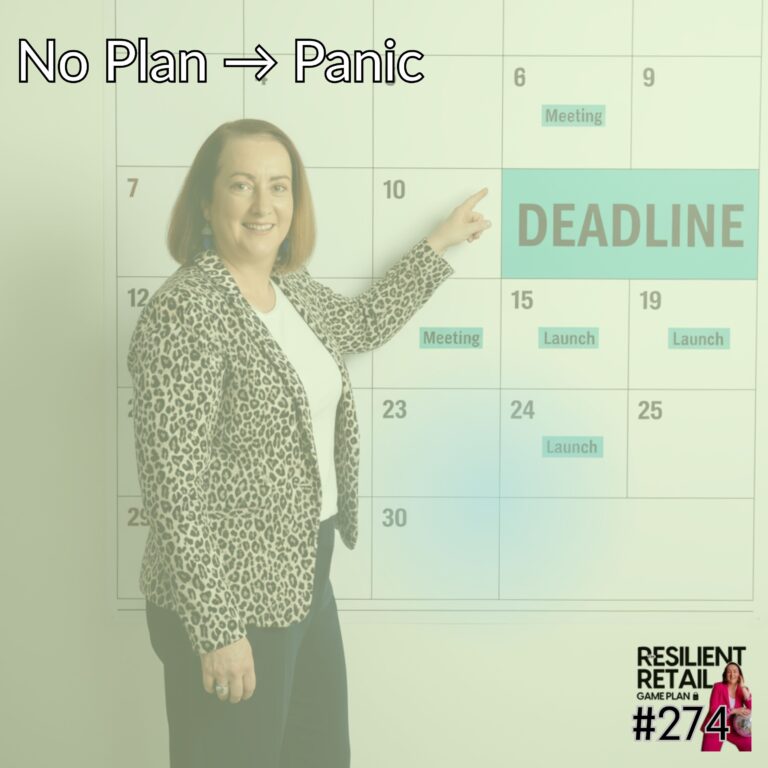
So for example, I might work with a client who’s represented on a lot of different websites and it’s taking up an unnecessary amount of time for them to keep all of those different third party partners updated when really it’s generating virtually nothing. We’re able to eliminate all of that work and just focus on the key channels. So offer strategy. Getting really clear is really a key part of helping you feel more focused. The sea of focus is calendar planning. And this can be really transformative. It’s a simple but powerful process of mapping out peak seasons, product launches, monthly sales goals. And this really helps avoid that feast or famine.
Catherine Edley [00:19:36]:
It helps you be proactive, keep on top of seasonal events and just generally move your marketing from feeling like a total overwhelm to a really clear structure. The U of focus is upskilling. So that is all about improving your own skills. When it comes to things like cash flow management, when it comes to things like stock control, team management, nobody is born with these skills. And a lot of the skills that you need to run a successful product businesses are not ones that you may even know what you don’t know, for example. So we go through all of the skills that you need as a founder to help you move to the next level. And then the final S is support, which is all about not only having support in retail by design, but we also look at the support that you have in the business, we look at the structure of the business and we look at what it needs for you to really be able to have that support and to, to be able to take the time out to step away. For me, when I talk to clients and they tell me they were able to take a two week holiday in August, that is success.
Catherine Edley [00:20:44]:
That is something that they maybe wouldn’t have been able to do before and it has a huge, huge impact on their lives and it has a huge impact on their businesses as a result. There we go. You have the Focus framework which is your foundations, your offer strategy, your calendar planning, upskilling and your support. It’s really all about moving from this scattergun approach being spread really thin to being more focused to being able to upskill to learn those behaviors that you need to do to take you out of the business on the day to day basis and carefully, strategically and profitably put in support. That means that the business can actually grow profitably. So success is not about working harder and you get to the point where actually you just can’t work any harder and have the business grow. It’s about working smarter and choosing clarity over chaos. So if you’re interested then you can head over to resilientretailclub.com and check out Retail by Design, which is my one to one program.
Catherine Edley [00:21:52]:
We are kicking off shortly. You can also head over to resilientretail club.com calm and get the Calm CEO Guide which has all of this in detail, the Focus framework and how you can go from being overwhelmed and scattergun to being calm, confident and focused. See you next week.
 Skip to content