260_Product_Pricing_and_the_Value_triangle_audio_version
Catherine Edley [00:00:00]:
If you want to build a resilient retail business, then you need to start pricing your products like a business and not like a hobbyist. In this episode, we’re going to be talking through pricing, step by step, discussing why it’s so difficult and how the value triangle, which covers price, quality and desirability, can help you feel really confident charging what you and your products are worth. Welcome to the Resilient Retail Game Plan. I’m Catherine Edley and in the next few minutes you’re about to get powerful real world retail strategies from insights shared both from my guests and myself, backed up by my 25 years in the retail industry. Keep listening to learn how to grow a thriving, profitable product business. Let’s jump in with this latest episode. Now, pricing is an absolutely fascinating topic and one that I love to dig into. And one of the reasons that it’s so interesting is that it stirs up a lot of feelings for a lot of people, which is why I sometimes feel like starting your own business can be a bit like a crash course in therapy.
Catherine Edley [00:01:06]:
But pricing is really something that cuts to the heart of all of those questions around money mindset. It can make what should be a very objective business decision into something that is quite difficult. So there are different pricing conundrums based on your business model. For example, if you are a reseller so you mostly sell products that other people send you, or that you mostly sell products from other retailers, retail businesses or brands, then you will be given ARRP recommended retail price by your suppliers. Now just a quick note on that. Remember that the R, the extra R is there for a reason. The recommended Nobody can actually tell you what you have to set your prices at, that there has to be a recommendation only to avoid things like price fixing. So no one can legally enforce and make you sell your products for a particular price.
Catherine Edley [00:01:58]:
However, it is often a little bit easier for you if you are a reseller because you are effectively given a product and you’re given an indication of what the price should be. Most of the time, product creators, whether it’s something that you’re making yourself or manufacturing, they face a different challenge. You’ve got to set your own pricing from scratch and that is what this episode is going to focus on. Now, there’s lots of concepts in this episode that will be really relevant for you if you are a reseller as well. If you’re somebody who is communicating to your customers about your products and their prices, there’s going to be lots that you’ll take away. Ultimately, the heart of this is about what do you do when you know that you need to set your prices and you’re not already given something to work from? One of the issues that I see come up a lot, and one of the reasons that I wanted to address this in this episode, is that undercharging is a real epidemic amongst small business owners. So what is undercharging? Undercharging is when you consistently charge lower than what the market rate suggests for your products. And it is something that a lot of small businesses do.
Catherine Edley [00:03:08]:
And there’s a few key reasons why it happens. One, simply speaking, undercharging often comes from lack of confidence and lack of confidence either in yourself or. Or in your product. So people might say, oh yes, I know that people do spend £90 on the Diptyque candle, but this is just my candle, so why would somebody pay that? Or perhaps you’re looking at it thinking, well, you can get other handmade brands for this price, but I think because it’s mine, would people really spend that much on my candle? So if there’s an issue about belief in yourself and your product, that can often lead people to end up undercharging to. The second thing that often people talk to me about is they’ll say, I want to create a product that is affordable for my customer. And therefore they feel like what they’re doing is effectively kind of a mission to keep their prices lower. And what I’d love to say to this, which is said with much love, is that what your customer can and can’t afford is none of your business. Now, somebody said this to me way back at the beginning of the my business, and it’s actually really quite liberating if you think about it, because if you’re going to be insistent that your customer can’t afford something unless you keep it a certain price, you can end up fighting with yourself and feeling like, oh, I can’t increase my prices.
Catherine Edley [00:04:24]:
But actually, the truth is, you don’t know what your customer can afford. And it’s not really your business to know. It’s your business to create a business that is going to be sustainable for you financially in the long term. A sustainable business has to support you financially. And if you don’t get your pricing right, if they can’t charge enough money for their products, then they can’t make enough profit and they can’t make enough profit, then they can’t pay themselves. And I can guarantee that if you can’t pay yourself from your business in the next three to five years, you will make a decision that this is just something that you can’t keep going with. If you really want to help your customers, be around for the long haul and don’t let yourself fall into that trap of feeling like, oh, I can’t charge more because my customer can’t afford it. The question of affordability is something that I find really fascinating because we often tell ourselves these stories about what people can and can’t afford.
Catherine Edley [00:05:16]:
The truth is, if people really want something, they will find the money for it. And you only need to look at the Latest tech fad, AirPods or things like that that you just think, reasonably speaking, you wouldn’t expect people to be able to afford, but somehow they do. So I think affordability can sometimes be something that we tell ourselves that is maybe a story that we tell ourselves that keeps ourselves feeling stuck. Three and the final reason that people tend to underprice is that they believe that low prices are more appealing. And of course, yes, there are psychological price barriers. I’m not saying that price isn’t important, but people will often say, oh, I can’t charge more because I just won’t sell anything. But don’t forget, there is also this idea of being reassuringly expensive. And ironically, I’ve actually seen people increase their prices and see their sales go up.
Catherine Edley [00:06:06]:
Because before there was this disconnect in the customer’s mind, they were naturally a bit suspicious, thinking, wow, if this product is really as good as they’re saying it is, then why is it this price? It just doesn’t make any sense. Pricing too low can backfire. It can lead people to believe that quality is not as good as you’re claiming. So if you’re ever tempted to just keep your prices really low because you’re convinced that’s the only thing that’s driving your sales, then I would challenge you to really have a listen to everything else that I’m saying in this episode about how you actually go about setting your prices in a logical way. Ask yourself, is it true that I have to keep my prices at this point? And sometimes, you know, I will absolutely put my hands up and say, sometimes there are people whose businesses the customer has a really, really clear price point in their mind for that particular product and it is hard to increase it. So I’m not saying that’s never the case, but I’ve also seen lots and lots cases of where people have told me categorically they can’t sell it for more, and they’ve actually gone on to increase their prices. And either seen no impact on their sales, but a big impact on their bottom line or actually seen their sales increase. So how do you know if you’re undercharging? Well, partly, as we come on to talk about later, we’ll have a look at how your products are priced compared to your competitors.
Catherine Edley [00:07:20]:
That’s a really interesting and obvious sign. If you wholesale your products into a retailer, they are quite happily pricing it up and selling it at more than what you’re selling your products for, then that is a really, really clear indicator that actually your products could be sold for a higher price. So for example, I worked with a baby skincare brand and they were selling, they had small batch production, they were selling it into a retailer. They weren’t really offering the retailer full retail margin, but the retailer was happy to take it in anyway. And I said to them, they seem happy with this pricing, just check what they’re actually selling it for. And when we looked on that company’s website, they were selling it for quite a lot more than the person supplying the retailer was selling it for. And that is a really good indicator that somebody else believes that your product can be and is selling your product at more than you’re selling it for. Another way that you can tell if you’re underpricing is how you actually feel.
Catherine Edley [00:08:18]:
And this, it may sound like an odd thing to say. One of the biggest indicators about underpricing is that you just feel really resentful. You think, I put all of this time and effort into this product and after I’ve sold it to the customer, this is how much I’m left with. And it just doesn’t seem right. It just doesn’t seem like it’s enough. And I think if you’re feeling resentful about the amount of money people are getting your products for, then that’s a really good sign that you need to look at increasing your prices. So how do you actually go about setting your prices? So how do you actually go about setting your prices if you are struggling with this? If you find it really difficult, get somebody who’s not as close to the business, who’s not in the day to day, a friend, a partner, family member who can help you be a little bit more objective. Make sure that they get what you’re doing.
Catherine Edley [00:09:12]:
They’re not going to tell you, oh, do you know what you’ve got to match as the prices or something like that. Make sure that they get the mission and what you’re doing, but preferably someone who’s a little bit removed. So they can help you be more logical. What I recommend in terms of the approach to setting your prices is that you start by setting your retail price, the price that you intend to sell to the end customer. Now, the reason I say that is that there is a school of thought that what you need to do is you get the cost price or the amount that you’re spending on creating the product, and you multiply it by two or four or whatever number people come up with in order to get your retail price. But I’m not a fan of that approach for several different reasons. First off, I think it’s not rounded in reality. I mean, you could do that.
Catherine Edley [00:09:56]:
I did actually meet a team once from Christian Labuta, and they were able to do that. That’s how they priced all their shoes. But that was Louboutin, you know, I mean, they could set those prices because they could say it’s going to be 800 pounds for a pair of shoes and somebody out there would pay it. But most of us don’t have that luxury. Most of us need to work within the parameters, the marketplace in which we’re operating. So therefore, we don’t just start by saying, these are my costs and therefore I’m going to multiply it by four and get my retail price. The other reason we don’t do that is because if your prices go up, then the only option you’ve got is to try and increase your retail price, which doesn’t feel right either. So I would suggest that you start by setting your price that you would sell to the end consumer.
Catherine Edley [00:10:39]:
If you’re somebody who sells a lot at wholesale, I still think you start with the price that goes to the end consumer, because ultimately the person who’s selling your product at the end, the retailer, they’re going to have to sell your product in that marketplace. So you’ve got to make sure that your retail price is grounded in reality. And this may sound obvious, but I cannot tell you the number of people who, when I asked them how they set their prices, they basically pulled it out of thin air, which for some people works, they go with that approach. But for most of us, we want to start by having something to pin our price on. So how do we actually set our retail price? Well, the first step I would suggest is that you find three similar brands to you in terms of materials, sourcing and production, not necessarily aesthetics. So, for example, if you are a baby clothing brand, then if you are making it in the UK with organic cotton, try and find other people who are doing the Same thing in the same way. There’s no point in you comparing your UK made organic cotton baby clothes to the Primark baby clothes, for example, because you’re just not even looking at anything similar in terms of the production method or the materials used. So try and find three people who are similar to you.
Catherine Edley [00:11:57]:
As I said, aesthetic is irrelevant. So if they’re bright neon and you’re scandi paired back, that’s absolutely fine. But we’re just trying to get a sense of the actual way that products are made and then have a look at how they are priced. Now, big retailers have software that scans all of their competitors and tells them what all the price comparisons are. But back in the day, we used to have to go out to the shops and go around with a notepad and make notes as to what all of the competitors were doing in terms of pricing. And it wasn’t about copying, it was about understanding the reality in which your customer operates. So that’s what you’re trying to do here. You’re just trying to understand if you’re in the market for a pair of organic baby leggings, how much might you pay or how much might you be able to get them from somewhere else.
Catherine Edley [00:12:44]:
So once you’ve done that, you effectively work out by product type what their pricing structure looks like, where it starts at, where it ends at, what the kind of range is, the products that they seem to sell the most of, where do they sit? And you get a really good sense of what’s going on. And once you’ve done that, you then decide your pricing in comparison. Now, there is no need for you to match it exactly if you don’t want to, you can do, you can say, right, everyone’s selling their leggings for £28. I’m going to pitch my leggings at that price. But also you might say, do you know what? Ours are hand finished, ours are reversible. For example, they’re all at 28, but I think we could go at 32. Whatever you feel is appropriate, you can do it, but you just need to benchmark it somewhere. So you either go in at the same parity, you go in above, which is the premium pricing model, or you might go below, which would be a value pricing model.
Catherine Edley [00:13:42]:
In other words, everyone’s at 28. I think we can bring ours in at 24 and still make an okay margin. So we’re going to go there. Now, I don’t generally recommend a value model for small businesses because before you know it, we’ll all be trying to undercut each other and that’s not good for anybody. And most small business owners are not going to ever be able to compete on price, especially when you compare it to big retailers. So don’t try the value model unless you’ve really got a compelling reason that you feel that you can come in under your competitors. Don’t do if it’s just a confidence thing. If you’re like, oh well, maybe their leggings are nicer than mine, I don’t think I can charge that now.
Catherine Edley [00:14:17]:
That’s not okay. You want to pick your pricing position based on your competitors, but it doesn’t have to be the same as theirs if you don’t want it to be. After you’ve done that, then you want to sense check with your customer. Customers. Now the most important thing is that do not go to your customers and ask them, would you pay 28 pounds for this pair of leggings? Because most people are aspirational. In other words, they’d like to think that they would spend 28 pounds on a pair of leggings or they’re trying to be nice so they’d say, yes, of course I would. But what you really want to understand is what their past behavior has been. You want to understand, for example, you could ask them when you’ve bought baby leggings and in the past, how much have you paid for them? And get an understanding of what they actually paid their actual real world behavior.
Catherine Edley [00:15:04]:
This gives you an anchor in real world insight into your prices. If everyone comes back and it’s a much lower than you expected, which often is the case because ultimately most small business owners are operating in effectively kind of a premium pricing model already. Most people are not competing on price. Ask them how much they paid when they bought it for a special occasion or for a gift. Because again, most small businesses, we tend to sit in that gifting price bracket because it’s not the cheapest that you’re going to get something, but it’s always the nicest. So make sure that you’re getting an insight not just into what they would pay on an everyday basis, but what they would pay in the case of something that they were gifting. And that will help give you some confidence around your, your pricing and where you’re sitting. Now, if you’re first starting out or you don’t have access to your ideal customers, have a think about somebody.
Catherine Edley [00:15:55]:
Do you know someone in the real world who would fit your ideal customer profile? Even if they’d never bought from you before, could you do a bit of research that way. In fact, I remember being told once when I very first started my business, before you start your business, you should talk to 100 potential customers and ask them what they want and ask them about their buying habits before you even get started started. So if you’re early on in your journey, how many people can you find and how many people can you ask about your pricing? So there you’ve set yourself your pricing, you’ve given it a bit of a check with some real world customer feedback, and then once you’ve done that, you can actually go back and check your margins. So last week’s episode was all about profit margins. So if you want a bit of a refresher on that, then go listen to episode 259. I’m not going to get into margins too much now. But even though profit’s really important, you always have to start with the final retail price and then at the end of that, work out whether or not it’s making you enough profit. This is the best way to do it because you’ve set your price in reality and now you’re going to check the profitability.
Catherine Edley [00:16:54]:
And the question is, what do you do if you do all of this and then all of a sudden you work out? Well, actually, I’m not making enough profit. I really can only sell these for 25, but it’s going to cost me £18 to produce. It’s much better to know about this now than to figure it out 612 months down the line or even several years into the business. And then I would encourage you to think about, are there any ways that you can tweak your costs? Can you simplify production? Can you use a different material, a different way of producing things? Can you negotiate with your supplier? Especially, especially if they’ve been supplying you for a while and you’ve got a good track record. Can you see if there’s anything they can do on their pricing? This is what big retailers do every single day. The number of meetings that I was in where effectively we’d be starting with a product, working out what the ideal price was for it, and then working backwards to get an ideal cost price. That is something that happens all the time. So if you’re working with a supplier, they will 100% be used to having this kind of conversation.
Catherine Edley [00:17:55]:
How can we make this cheaper? How can we bring the costs in down for me? The thing is, is you mustn’t compromise on something that is core and essential to your business. So, for example, if we’re saying, can you make it with cheaper materials? If you have a certain fabric that you use that is absolutely your calling card, do not change that. But is there something else that you can do? The supplier also will be able to help you. If it’s not something you’re making yourself and you’re having it manufactured for you, then ask them what would it take to bring it in at this point, this price? They may be able to help you come up with some answers. Because often the things that cost money in the manufacturing process, they’re usually related to time. So if you want a particular effect or a particular stitch or a particular type of construction, but it’s taking a really, really long time, then that is usually going to be adding cost in. So if you’re trying to bring your cost down with the manufacturer, make sure that you are asking them to run through ways that you could bring the cost down and some of them will be acceptable. They might say, well we could try changing the placement of this item and actually you don’t really mind, but it makes the production that much quicker.
Catherine Edley [00:18:58]:
But other times they might say, well, you’d need to switch out this for this and that’s just not acceptable. So know what your non negotiables are, but don’t be afraid to have that conversation with your supplier because they will be used to it. Big retailers do this all the time. They say, okay, how can we make this work? And if you’re making it yourself, have a think about the supply. Same thing is, are there any elements that you can switch out, other ways of producing things that take less time? The other thing that I would say as well is really importantly, you must make sure that when you’re checking your margins, if it’s a handmade item, that you’re factoring in your time as well to make sure that you have that cost covered. So once we’ve set our prices, then we’ve checked our margins, we’re happy that they are where they need to be. How do you communicate your price to the customer? Now that might sound like an odd question because obviously your customer could go onto your website and they can see your price. But I think one of the most important elements of pricing is understanding that customers don’t buy based on price alone.
Catherine Edley [00:20:02]:
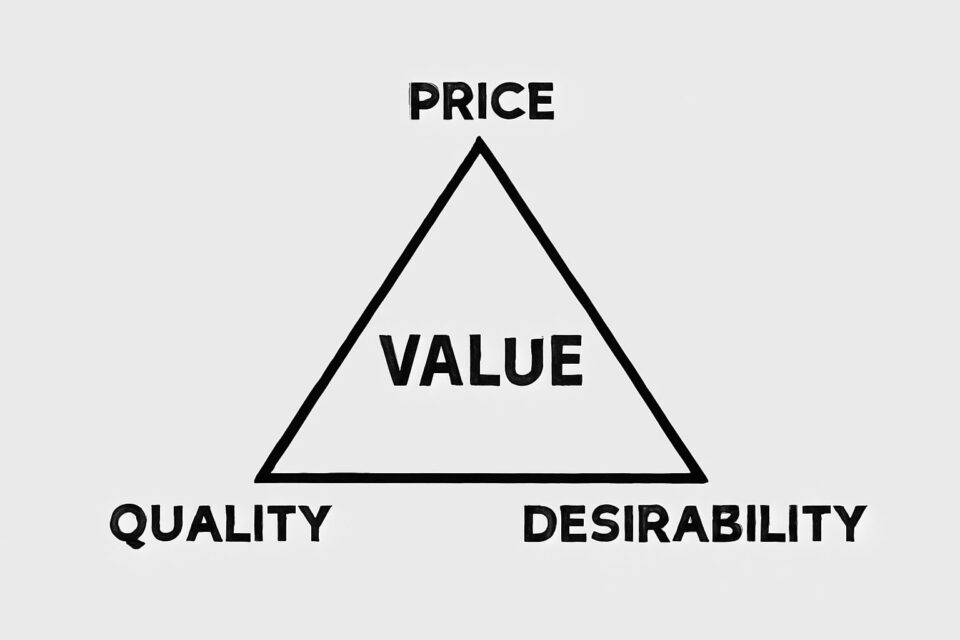
Customers buy based on value. So that is effectively whether or not they consider the item that you’re selling to represent good value. If they believe it represents good value, they will buy it. And if they don’t think it’s good value, they won’t buy it. This is what I call the value triangle. The value is made up of three things. The price of a product, the quality of the product and the desirability. So to dive into that in a little bit more detail, all three of those have to be aligned for something to sell.
Catherine Edley [00:20:34]:
So if we take an example of two pens, back in the day, I worked at Paperchase and we had two pens that were best selling for different reasons. The number one unit seller was the Bic Biro, a black Bic Biro for £1 50. It was great value for the customer because they knew that it wasn’t super high quality, but they knew it would write it was the right price. And therefore it was what you’d call a commodity product because it was all about low price and acceptable quality. And we sold lots of those. That was our number one unit bestseller. It did the job, it got things done and people were happy to pay £1 50 for that. But then we also had a 65 pound fountain pen that was one of our best sellers in terms of sales value.
Catherine Edley [00:21:20]:
Now this had desirability, it looked beautiful, it was high quality, well made, would be long lasting. And therefore the price of 65 pounds felt like it was good value because everything else was aligned and they did a lot of around desirability, limited edition colors and that kind of thing as well to really kind of trigger that. But ultimately it was about having a beautiful pen that was well made, that felt like that £65 represented good value. So the word value is not synonymous with cheap. It’s about, do you think that the money that you’re paying for this is worth it? If you find that you’re struggling to set your prices at the right level, if you feel like, I know that this needs to be 60 pounds, but I’m really struggling to get people to understand that it should be £60 and everyone thinks it should be cheaper. The question you have to ask yourself is, am I doing enough to communicate the quality of this product? Let’s take another example. We’ve got two black bags. We’ve got one is 15 pounds and one is 250 pounds.
Catherine Edley [00:22:33]:
And if you just had them side by side, no explanation as to the two bags, then yes, obviously one you could tell one would be better quality than another. But you would have to really love the 251 to say, right, this is definitely the one I want to go for. But imagine that instead of just it being £250, there was a whole story around this bag, that it was made from leather off Cuts from the leather industry. Therefore it was reducing waste. The interior had a lining made out of recycled polyester from bottles that would otherwise go into the ocean. So recycled ocean plastics to make the polyester for the inside. The bag itself was made in an East London atelier by women who had been stitching bags for high end fashion houses for the last 40 years. And as you can see, the storytelling element of this, the story of the production, the story of the quality of the materials used, the purpose behind it, that all of a sudden starts to become a lot more interesting and a lot more desirable and the value starts to make sense.
Catherine Edley [00:23:48]:
So the great thing about this is it makes great content, it’s great storytelling content and it can really, really help you illustrate your customer why they need to spend that money with your brand as opposed to picking up the 15 pound mass produced tote instead. This is really the value triangle in action. And I would suggest that if you do not feel that you’re able to charge the prices that you know that your products deserve, really look at the way that you communicate that value to your customer and see if there’s ways that you can illustrate it in more depth. Can you show behind the scenes footage? Can you show the people who are making the product? Can you show the process? For example, Indian block printing, it’s such a labor intensive technique and it’s absolutely fascinating. If you have block printed products, are you explaining to people what that means? Because people don’t know. And it’s always useful for you to remember that you have to explain this to your customer. You are in the weeds all the time in your business. You know why it costs, but your customers don’t until you tell them.
Catherine Edley [00:24:52]:
So if you’re struggling to get the prices that you need, make sure you’re communicating it. One of my mantras is if it’s worth more, charge more. But explain why that explanation piece is absolutely crucial and desirability is the final piece as well. So desirability, it’s completely subjective. I’ve worked in lots of different businesses and worked with hundreds of different businesses and I can tell you that their number one bestseller is often extremely different ones to the other. But the thing that unites all of them is that they are something that the ideal customer really wants. It is really tuned into the ideal customer and it’s getting an emotional response from them. So this is something that it’s hard to manufacture.
Catherine Edley [00:25:38]:
Exactly. But you’ve got to keep going. Got to remember that the more your product is completely attuned to what your ideal customer wants, the easier it will be to sell. And also it gives you what I call price elasticity. So it’s not like you can charge twice as much for something that somebody really loves, but you want them to have an emotional response to it. You want them to just really want this item because then they don’t ask as many questions about the price. So if you’re struggling with pricing, ask yourself, is this the best product for my ideal customer? And also, are you doing enough to explain to the customer the ins and outs and the why behind why something needs to be the price that it is? If you think your prices are too low, then why not take a minute to go back over the process that I outlined in this episode, Reassess where you sit in the market, talk to your customers, and then once you’ve done all of that and you’ve assessed, do you need to change them? Do you need to tweak them? Then check your profitability. And if you’re struggling to get the prices that, that you know that your products deserve, then make sure you use the value triangle concept to help guide your messaging.
Catherine Edley [00:26:46]:
And the other thing I would say as well is that if you haven’t checked your prices against your competitors in the last three to six months, check them again. Because it used to be something that we could do once a year, but in the era of rising prices all the time it stabilized a little bit. But still you need to be double checking that the whole market hasn’t moved. And I’ve had this conversation with a few people where they say, well, I can’t charge more than that this for a T shirt because that’s what everyone else charges. And then we’ve double checked and everyone else has been putting their prices up. So make sure that you can, hand on your heart, say that you’ve got the most up to date information. And just remember that customers don’t pay for products, they pay for perceived value. So if it’s worth more, charge more.
Catherine Edley [00:27:26]:
But make sure you explain why. And if it feels really hard, then help bring somebody objective into the process and be brave. You might be surprised by how well your customers actually end up responding. Thank you so much for listening. Do take a moment to follow the podcast or subscribe whatever platform that you’re on and if you have a minute to rate and review it inside Apple Podcast that makes all the difference. See you next week.
 Skip to content