Catherine Edley [00:00:01]:
In today’s episode, we’re going to walk you through three mistakes that keep small product businesses stuck and how to avoid them so you can finally start building real momentum. If you feel like your sales are stuck in first gear, then this episode is for you. Maybe you’re showing up on Instagram, perhaps you’re boosting posts sporadically, perhaps running the promotion, maybe you’re going to events or in person markets. But when you look at your revenue, it’s still seems like you’re pretty much always stuck in the same place, somewhere between 1 to 3k a month. And it’s frustrating, isn’t it? You’re working really hard, yet the numbers just aren’t moving. And at that point, it’s easy to start questioning yourself, is this business ever going to grow? So if you’re in this zone, then this is the episode for you. We’re going to be talking about the reasons that people get stuck here and how you can fix them. Because here’s the thing, being stuck at this level isn’t a sign that you’re failing.
Catherine Edley [00:01:01]:
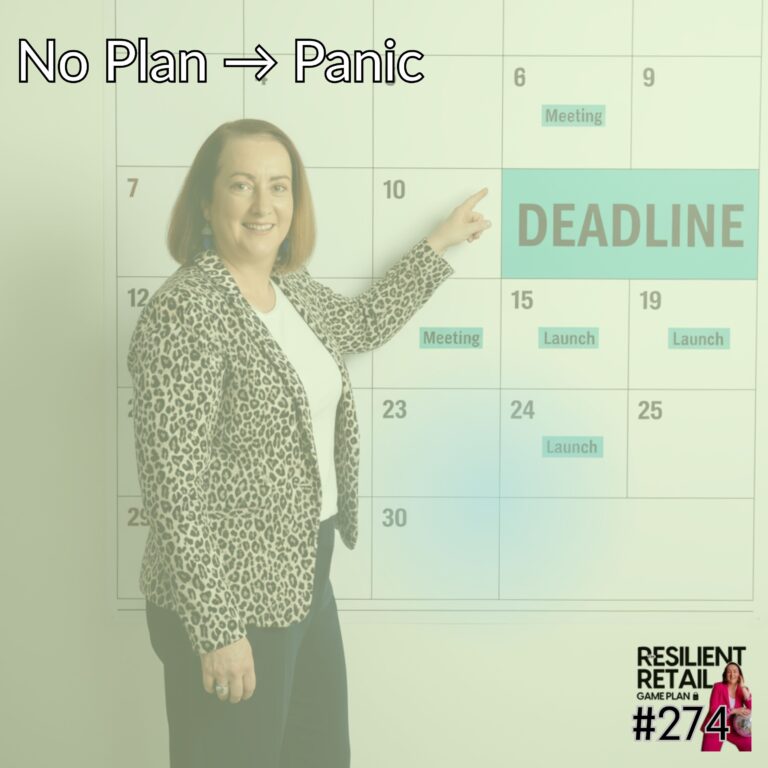
It’s not a sign that nobody wants your products or the business was a terrible idea. More often than not, it’s because of three common mistakes. And the good news is these are things that you can fix. So the first mistake that I see people making is that they don’t have a clear plan. Often when I talk to people about their business, I will ask them, do you have a plan? Do you have a sales plan? Do you have a marketing plan? Do you have a plan for launching new products? Do you have a plan for what you’re going to talk about when. And usually the answer is no. A lot of people don’t have a clear plan mapped out because they’re often going from one thing to the next. They are bouncing, they’re being very reactive.
Catherine Edley [00:01:43]:
Maybe an opportunity comes up, so they’re answering that, or something else is coming up, so they’re answering that and back. Basically, they are letting themselves be kind of bounced around like a ball. Whereas my background in retail, I’ve been in the business for 25 years. What I’ve learned is that the big guys spending nearly two decades in bigger retailers is that everything is planned out Now. A lot of people feel like planning is tough, is difficult, or not even so much that they feel it’s difficult, but more that they feel like it’s restrictive. Maybe you started a business because you’re wanting to be creative, you wanted to express your creativity, and it feels like planning is the opposite of being creative. But I’m a really big believer that planning and creativity are not mutually exclusive. In fact, they very much feed in to one another.
Catherine Edley [00:02:33]:
Once you’ve got a structure and a framework and a plan around you, you can actually be more creative because you know what you need to do and you just come up with the ideas for it, as opposed to feeling lost and feeling like you’re kind of just being bounced around from pillar to post. So what I see with a lot of people is that they rely on ad hoc posting spur of the moment ideas. So they’ll sit there on a Monday and think, right, I really should post something this week. And they don’t really know what to say. They don’t have a coordination between their product strategy and their marketing strategy. And I think for me that’s one of the biggest missed opportunities. Because the thing about retail is that it varies a lot throughout the year. It’s very, very seasonal.
Catherine Edley [00:03:17]:
So what your customer wants from you and the kind of messages that work with them in the summer are going to be very different from the messages that work with them at Christmas time, or in fact in January or February. So there’s a lot of shift and change throughout the year. There’s lots of nuance to what people want from you in certain seasons, and there’s lots of different themes and ideas and opportunities to talk about things that are different month on month. So, for example, very broadly, what you’re going to talk about in February, if you are a jewelry brand, is going to be centered around Valentine’s Day. And what you talk about in March is going to be sent could be centered around Mother’s Day, for example. So those are just two very basic examples of how what you want to talk about is going to vary throughout the year. And if you don’t have that all mapped out, it can feel quite overwhelming. Like I said, it can feel like you’re a ping pong ball being bounced around thinking, oh, I should be doing something, maybe I should say something about Valentine’s Day, oh, maybe I should say something about Mother’s Day.
Catherine Edley [00:04:16]:
And the upside is that although it does change a lot and it shifts week on week, and arguably that’s what makes it so exciting, it stays the same year on year. So once you’ve cracked that seasonal element to your business, once you’ve really delved in and understood what your year looks like, and obviously it will shift, one year is not going to be the same as another year. But broadly speaking, there are going to be themes and ideas that work year on year, once you’ve got that, you can repeat it. It is repeatable. The benefit of retail, of product businesses over service businesses is that predictability and that repeatability, that opportunity to scale and grow because you’ve figured out a system and then you’re repeating it. So, for example, if you don’t have a plan, you are going to potentially miss some major opportunities to connect with your customers because you’re not going to be zoomed out and looking at that big picture. For example, I was talking to a men’s gifting brand and this was in May, and I asked them about Father’s Day and it wasn’t something that they’d considered. Now, if you’re a menswear, arguably you have or a male focused brand, arguably you have fewer opportunities or not such big seasonal opportunities because, for example, Valentine’s Day tends to be more heavily skewed, broadly speaking, towards female gifting.
Catherine Edley [00:05:47]:
And obviously Mother’s Day is different. It’s not going to work for you if you’re a male orientated brand. However, if you miss Father’s Day because you just didn’t look at the year in a zoomed out way, then that is a major opportunity that you’ve missed. And I see it every single year at Christmas. Every single year, I speak to people in November. I ask them all the way up to November, even into December, I’d ask them about their plans for Christmas and they kind of say, oh yeah, I suppose I should come up with something. Well, this is the thing. You can eliminate so much of the last minute aspect of retail.
Catherine Edley [00:06:24]:
You can plan it. You know, big retailers are planning 18 months in advance, two years in advance. Now, arguably, yes, that is the extreme version and it can lead them to be a little less reactive than they would like to be and a little more constrained. But the you can plan in advance and the more you plan in advance, the more you’re able to roll with the punches when something unexpected does happen. If you’ve done lots of prep in advance, then you are able to deal with that without it completely derailing everything. And then the other reason that I feel that not having a plan is really difficult is because if you think about all of the different ways to grow your sales. So for example, episode 264 of the podcast was about four ways to grow your sales. Without a plan, you can’t really ensure that you are tackling all those four ways consistently and you can’t create a really nicely aligned, up aligned plan across all of your channels.
Catherine Edley [00:07:24]:
If you and all of your marketing channels, all of your selling channels, and all of your marketing channels if you don’t get it mapped out. Okay, so mistake number two is not having a product strategy. So in a similar way that people often will tell me they don’t have a plan for their marketing, I would say that another common issue is that they don’t really have a plan for their products. So I’ll ask them, do you have a plan for what you introduce when? And the answer is usually no. And I’ll ask them, do you know what your best sellers are? That’s not always a given. Either some people aren’t really sure or they think they know, but they haven’t actually checked. And the reason that I think this holds people back is because all of retail, all of business, I guess, could be boiled down to do more of what works and do less of what doesn’t work. And so if you don’t have a plan for your products, then you are unable to really maximize the data that you’ve got.
Catherine Edley [00:08:26]:
And yes, if your sales are lower, you might not have a huge amount of data. But especially if you look at it on a monthly basis, look at what your best sellers are, you need to understand what is moving the needle, what people are reacting to and what they’re not reacting to. And I would say that in this first bit of the business, when you are at that kind of 1 to 3K, you need to be figuring out what your customer wants from you. So you need to be figuring out what they’re reacting to, what is selling. And if nothing is selling, if nothing’s working, then you need to go back to the drawing board on a repeated basis, checking in with your customers, what do they want from you. Trialing things in as low a risk as possible to try new things to move on. But you need to try things and learn from them. It’s not about just scattergunning, bringing in lots and lots of different new things.
Catherine Edley [00:09:16]:
It’s about creating a hypothesis, checking it. Is that what they want? Let’s try something else. Let’s tweak it. Let’s tweak what the product offer is. Let’s tweak how I’m talking about it, how I’m talking about the benefits to the customer versus the features, all of those things. You want to test that over again, see what the result is, and then move on from there. So bestsellers, understanding your bestsellers are really, really important. They, they help give you confidence and they help you really understand what you should be focusing on in Your marketing, that’s another issue that I see people having is that they think that, oh, well, if something’s selling, I don’t need to be shouting about it.
Catherine Edley [00:09:56]:
Whereas actually you often get much more traction by really shouting about your best sellers. Because this is all a game of probability. You want to really focus on what your customer is most likely to purchase from you, and that may well be the thing that you sell the most off. So you want to focus on that and you want to lean into it. So if you don’t really look at your products and really understand what they’re telling you, then you’re going to miss some really important clues, really important green shoots if you like, to help move you forward. And then the other thing is that if you don’t have a really considered plan for your products, it feeds back into my first point about no clear plan overall for the business. Because really your marketing plan and your product plan are very, very closely intertwined. Because if you go through and you look at your year and you understand, right, these are going to be my peak selling times, well, then you want to coordinate your products.
Catherine Edley [00:10:55]:
If you’re going to bring new products in, make sure that the products are coming in at the right time, seasonally speaking, making sure that they are the right products for the right time. And you really want the whole thing to be tied up together. But if you, you don’t have a plan for your marketing and you don’t have a plan for your product, then what you’re left with is two very disjointed activities that are really time consuming. Marketing’s really time consuming. Product development or product making new products or sourcing new products is hugely time intensive as well. And if you’re not doing it in a coordinated fashion, it can end up getting very, very messy. And then the third mistake that I see people make that really holds them back is related to this idea of knowing what’s working. But if you don’t have a plan and you’re doing everything in a very reactive way, then the other thing is that you don’t really have a good idea of what you’re doing, what’s working, and what you need to lean into in the same way that we talked about for your products.
Catherine Edley [00:11:58]:
That goes for everything that you’re doing in terms of your sales channels and your marketing as well. So sales start to feel sporadic. You have good days and bad days with no clear explanation. Now, here’s something else that I would say to you as well. One of the things that is particularly True, especially at this early stage, is that everything feels really, really personal. So lots of people I know will say that I just feel, on a quiet day, it completely wipes my confidence. And I totally get that because nobody tells you when you start a business how nerve wracking it is to create or curate things that you feel really strongly about, to put them out in front of other people and to say to them, hey, buy this from me. It can feel incredibly challenging, incredibly triggering for a lot of people, and it can feel just really, really difficult if you’re not getting the response that you want.
Catherine Edley [00:12:56]:
So what happens is when you’re not really closely tracking your numbers and you’re not really closely tracking your actions, it feels, it can feel very sporadic. So one week things will do great and the next week things will go really quiet. And you can feel, therefore a lot of. There’s a, it’s a real roller coaster for a lot of founders. They feel very personally upset when things are quiet. They say to themselves, oh, I must be really bad at this. People really hate what I do. This is such a bad idea.
Catherine Edley [00:13:31]:
Everyone thinks it’s a joke, what I’m doing, all of those things. And it just really feeds into this cycle of not having a plan and not having a structure because it doesn’t feel, you don’t feel like you have the right to have a plan, or it doesn’t feel like this is something that you should do, because this is. You’re maybe not giving having enough confidence in the business to say, right, no, this is what I’m planning to do. Because the nervousness I see from a lot of people is that they feel like, well, if I make a plan and I don’t hit it, am I going to feel even worse? Whereas what we’re really talking about here is not so much, oh, you can only have a plan if things are going well. But we want to try and shift as much as possible from a subjective point of view to an objective point of view. And this is the benefit that I have from my long years of experience in the retail industry and two decades in big retailers, is that they have to be completely objective. And what I mean by being objective is that that they really put a plan in place and then every week they’re looking at the plan and they’re seeing whether or not they’ve hit it on what they need to do to adjust it. So it’s about a process.
Catherine Edley [00:14:43]:
And obviously in big retailers there is much less room for people to be so caught up in that kind of personal, oh, I failed or I’ve done something wrong. I mean, obviously everyone has personal feelings and people have selected products that haven’t worked and that can feel really difficult too. But ultimately what it’s about is the setting a goal, setting a plan in place and then reacting to it. And that’s what I’m talking about when we’re thinking about being more objective than being subjective. And what can happen if you get too caught up into the emotion of it? You start making knee jerk reactions. So, for example, you launch something it hasn’t sold, you think, oh, maybe I should take some money off it, discount it, instead of thinking, right, okay, did I do enough promotion? It’s almost like we get these negative feelings and we want to just do something to try and alleviate them rather than actually looking into it and saying, right, what was the actual plan? So it’s, it’s also something that I would really stress that the benefit of having that plan is that retail fluctuates a huge amount. It fluctuates a lot, month to month. But as I’ve mentioned before, it’s on an annual cycle.
Catherine Edley [00:15:59]:
It does repeat. So learning things like when you’re going to be quiet can really help with that confidence building and really help you understand when you’re going to naturally be quieter and then get to helping you get ready for the busiest times as well. So if you set yourself a plan, then yes, of course you may have weeks and months where you don’t hit it. But it’s still better to have that plan in place than for you to be so caught up in the emotional side of it that you really end up almost beating yourself up if things aren’t going so well as instead of thinking, right, what do I need to do now? What can I try next? So what I would suggest that you do is take the time to set those goals and make some time to, Even if it’s 10 minutes a week to really look at, right, how am I doing? How am I selling? How am I doing compared to my plan? What’s working, what’s not working? And which of my sales channels are really are performing for me. And it, I totally understand why people don’t do this because it can feel very upsetting if you look at something and you think, wow, actually I’m not really selling that much or this is not what I thought it would be. But I really do believe that there’s a lot of power that comes from really knowing the truth of your situation. Whenever I’ve had times in my Business where I’ve stuck my head in the sand and not really addressed what’s going on. I’ve always felt so much better when I’ve taken the time to sit down and really go through things and get an actual accurate picture.
Catherine Edley [00:17:37]:
And also, I can’t tell you the number of times that people will have sit down and run their numbers and actually they’re better than they thought they were. In fact, somebody in the club mentioned that they had always thought to themselves that they would feel like they’d done well when they hit a certain revenue number. And it turns out because they’d been not looking at these things, they were feeling stuck and in denial. They hadn’t looked at their numbers and they’d actually hit the revenue number that they’d been aiming for. But they hadn’t realized it because they hadn’t looked, they hadn’t engaged because they caught up in these feelings of insecurity and just not feeling like they, they wanted to engage with the numbers because they were scared of what they might show them. So if you’re stuck then around that 1-3k month, 1-3k of sales a month level, then it’s probably not because you’re doing anything wrong. It’s because of these particular mistakes that I see people make. Those are things like, for example, not having a clear plan, not having a product strategy, not having visibility of what’s working and all of those things that keep you on a sales plateau.
Catherine Edley [00:18:46]:
So the good news is, is that every single one of them is fixable. You can definitely take the time to work your way through and. And maybe it’s sitting down and sketching out a seasonal plan. Maybe it’s identifying your bestsellers, maybe it’s starting a sales check in with yourself. But whatever you choose, make that one small step towards helping move you past that plateau. And if you’d like some more support with this, then we have the retail sales game plan. The doors are open for this course. It is the first time I’m running this course.
Catherine Edley [00:19:18]:
I’m really excited about it. We are going to look at everything that you need to put some plans into place, some structure, some strategy and help you really get a grip on with how to grow your product business. Thank you so much for listening and I’ll see you next week.
 Skip to content


 Planning can feel restrictive, especially to creative people. But in retail, structure isn’t the enemy of creativity — it’s what allows it to thrive.
 But how do you know which of your products are actually great?