Catherine Edley [00:00:00]:
Sales are coming in, but bills are going out faster. If you’ve ever woken up at 3am and wondered how are you going to cover the next bill or felt like you’re constantly robbing Peter to pay Paul, then this episode is for you. Welcome to the Resilient retail game Plan. I’m Catherine Edley and in the next few minutes you’re about to get powerful real world retail strategies from insights shared both from my guests and myself, backed up by my 25 years in the retail industry. Keep listening to learn how to grow a thriving, profitable product business. Let’s jump in with this latest episode. One of the things I’m most passionate about is helping product businesses improve their cash flow. And that is because cash flow is make or break for businesses.
Catherine Edley [00:00:49]:
If you look at any statistics as to why businesses fail, then you will see that the number one reason is always cash flow. Because ultimately you get into a situation where you just, if you can’t pay your bills, you can’t have a business. It’s as simple as that. And I do love the phrase turnover is vanity, profit is sanity. But then there’s a third element which is cash is reality. So what we’re going to be talking about today is how to take back control of your cash flow and also understand more about where your money’s going out and how to get more of it to stay into your account. When I talk to people who are feeling stressed in their business, it’s because they’ve got a particular need, they’ve identified an issue and they’re looking for a solution. So whether I’m talking to them about my stock doctor service or my retail by design one to one work, then usually they’ve come to me because there’s something going on in the business what links them all together, whether or not they are actually doing really, really well and super profitable and in fast growth mode, or whether they’ve hit a plateau or, and everything in between is they feel out of control and they feel like they don’t have visibility.
Catherine Edley [00:02:01]:
One of the things that makes cash flow so difficult for so many people is that it is really multifaceted. There are sales coming in and there may be sales coming in from four or five, six different sources. There are bills going out and those bills cover everything from bills you pay once a year to bills that you’re paying every month to bills that you’re paying every week and also then those kind of big outlays of cash. Especially if you’re somebody who manufactures. That’s particularly difficult because Paying for a production run up front is really, really tricky. And what happens is this. All of this money effectively flying around is coming in, it’s going out, and it can feel just like a bit of a whirlwind, even when it’s doing well. Sometimes I see people who’ve got money in the bank, but they’re scared to spend it because they don’t know if they can have enough to cover everything else.
Catherine Edley [00:02:54]:
And then there’s people who are at the bottom of their overdraft or juggling multiple loan repayments. So there are a whole host of different situations with cash flow. But in a way, regardless of whether your cash flow is good or whether it’s bad, not being able to have it mapped out and really clear and in front of you is an extremely stressful situation. I absolutely love nothing better than helping people unpick what’s going on with their cash flow and getting it sorted out for them so they have a clear spreadsheet that they have got it all mapped out and they can see it in front of them. And what I wanted to do in today’s episode is talk about how you can improve your cash flow if it’s something that you’re struggling with. And also the importance of having a plan, effectively being able to see it. The other thing I would say as well is that another reason I think this, people find this really difficult is that cash flow and taxes and business finances, the kind of things that your accountant might help you with, they’re often very different things. So what works for you as a business owner and what works for your bank account and what hmrc, the information HMRC want to see that different things.
Catherine Edley [00:04:05]:
And what we’re talking about is really grounded in the reality of what it’s like day to day as a business owner, to go from running your whole business on whether or not you think you can cover something based on what’s in your bank account, to actually feeling like you’re in control and you can see a year ahead of you what your bank balance is likely to be on any given date. So let’s talk through the cash flow framework, because I think the first step towards having a better cash flow is understanding all of the different things that impact it and how they all relate to one another. The acronym I like to use for this is shops. Very appropriate for the retail industry. And what SHOPS covers is the different elements that impact your cash flow. And we’re going to talk through them. So just top line, the SHOPS stands for S for Sales, H for Having it all mapped out. O for overheads, P for profit and S for stock.
Catherine Edley [00:05:04]:
So all of the different elements that go into impacting your cash flow and all of the different things that you need to look at if you’re finding cash flow really difficult. So let’s start with the S, the first S. Sales. Now this is interesting because I can tell you that most people, if you ask them what they need to grow their cash flow, they’re going to tell you that they need more sales. And I’m here to tell you that more sales are great. That is very helpful for people, especially when they’re very first starting out and they are making very, very few sales. But you can also have a business with lots of sales and a really difficult cash flow. So don’t fall into the trap of thinking that all you need to do to resolve your cash flow issues is have more sales.
Catherine Edley [00:05:49]:
So they are important. As I said, if you’re only making one sale a week and you’ve got overheads, then clearly the only way to improve your cash flow is going to be to grow your sales. But there’s also lots of people who scale and they hit six figures and they get beyond six figures and they’re just more stressed and the business is more unmanageable because they don’t have it all mapped out. So the key thing here to say is that yes, sales are important. They aren’t the only thing. There’s lots of other things that you can do to help make your cash flow feel more manageable without only relying on more sales. The other thing I want to just highlight as well is that you need to make sure that they are profitable sales. I talk a lot about pricing, I talk a lot about profitability.
Catherine Edley [00:06:31]:
You may have heard me say this before, but ultimately it’s not about the top line sales, it’s about how much profit they’re bringing into you. Because another issue that I’ve seen with people with cash flow, for example, is they’re plowing a lot of money into advertising. And if you’re not careful and you’re not keeping a really close eye on your roas, your return on ad spend, then you can get yourself into a situation where you’ve got sales coming in, but ultimately your cash flow is really difficult because there just really isn’t much profit or your pricing isn’t set up correctly and therefore you need to review that and improve your profit margins to grow your sales more profitably. If you want any more information about that, then episode 259 is all about profit margins. Episode 260 is all about pricing. So you can go back and check those out if you want more detail on that subject. But just to say that yes, sales are important for your cash flow, but don’t fall into the trap of thinking, oh, once my sales improve, my cash flow will be sorted. That’s not true.
Catherine Edley [00:07:31]:
And it can lead you to put off really delving into your cash flow for quite some time because you think it doesn’t apply to you yet. And then before you know it, the numbers have got bigger, the stress has got bigger and you find yourself in a tricky step situation. So that’s where H, the H for shops having it all mapped out comes in. So having it all mapped out is about being able to actually see what’s going on with your cash flow. So this is a cash flow forecast. Now if you go To Resilient retail club.com cashflow, you can download my form free Cash flow forecast template which will help you with this enormously. So if you have ever struggled to find cash flow planner that works for you because it’s not set up for product businesses, then go check this one out. I’ve been so frustrated over the years with trying to find a good tool to recommend to clients to help them with their cash flow that I basically ended up creating my own.
Catherine Edley [00:08:36]:
The biggest issue I have is a lot of the software out there. For example, for cash flow for small businesses businesses, it’s really set up for service businesses. So it talks a lot about things like how many proposals do you have out right now, how many potential clients, what’s your potential future income? Whereas actually for product businesses, that’s completely irrelevant. You need to be able to capture all of the different elements that you’ve got going on. What your sales forecast is by channel. You need to be looking at things like your bills, your stock purchasing, your salaries, so on and so forth. So having it all mapped out is an absolute game changer. And in my Retail by Design one to one program, I work with a lot of people on this one to one.
Catherine Edley [00:09:18]:
So I walk through it together and I get them up and running and using it on a weekly basis. And I can’t tell you the number of people who tell me I really hated spreadsheets, but I love this one. And the reason that it’s so transformative is that it shows you the timing of everything. It’s a week by week spreadsheet that you update once a week and it allows you the power to understand the how much money you’re going to have in your account at any one time the power that that gives you. It means that if you have to make a big purchase, you can see the timing of it. You could also negotiate from a much stronger position with people that you maybe owe money to. So, for example, let’s say you’ve got an invoice that’s outstanding. Rather than thinking, oh my goodness, how am I going to do this? Potentially, you could have a conversation with them which would say, I’ve done my cash flow planner.
Catherine Edley [00:10:08]:
If I could split this into two or three installments, that would really help me. Is there any way that we could do this? And of course, they may just say no, but it’s a much stronger position, a much more credible position to come from when you’ve got it all mapped out and you can have those kind of conversations with people then instead just feeling like you have to, maybe you can’t make the payment that they’re expecting and that that creates all kinds of other difficulties. It’s also about it being really visible. And I’ve worked with people where we’ve done this cash flow planner and it’s been really difficult to see. And I’ve worked with people where it’s given them a lot of confidence because they’ve been able to see how much they’ve actually got. But even for the people where it was really tricky and really difficult, it really highlighted where the issues were in their business and it helped them map them out. So I’m excited to share it with you. As I said, go to resilientretailclub.com cashflow and you will be able to download your free planner with an explainer video.
Catherine Edley [00:11:06]:
This is a game changer if you can get it all mapped out. It’s the difference between feeling like you’re doing okay and knowing that you’ve got what you need. And I really highly recommend it. It doesn’t have to take forever to set up, but it can be really, really powerful. And as I said, I actually don’t know how people make decisions in their business without being able to see the cash flow. Because also once you’ve got it all set up, you are able to really create something that if you want to bring in a new person or you want to spend money on something, you put that payment in the time at which it’s going to come out and then you are able to decide, is this something that I want to do? So you can actually make those decisions before you do them in your business. Okay, so now let’s move on to the O the overhead. So this is about understanding, understanding your regular fixed costs like your rent, your staffing, your software.
Catherine Edley [00:12:06]:
And this is a really good exercise to just double check. So if you are struggling with your cash flow, I would say most of the time when people are struggling with their cash flow, it’s usually to do with the profitability or to do with the amount of stock that they’re buying. But sometimes it’s because their overheads are really heavy, are really onerous. But it’s really good to know that and it’s very good to double check all of your overheads. And the key thing to remember about your overheads is the amount of money that you have to generate through sales to cover any expense in your business is quite considerably more than that expense. So if you have something that costs you £100amonth, then the sales that you have to generate, depending on your profit margins, is probably more like £250. So anything that you can do in terms of your overheads or your fixed costs and bringing those down will help your cash flow enormously. So it’s well worth doing a bit of housekeeping to make sure you’re keeping on top of that.
Catherine Edley [00:13:05]:
And then the P is for profit. And again, if you want to know more about profit margins, then check out episode 259. Margin absolutely matters, and it’s where many businesses fall down. And ultimately, if you haven’t got good enough profit margins, what you’ll see is that you really feel like you’re on a treadmill. So as you’re generating sales, the money that’s coming in from those is coming in slower than the money is going out to cover the cost of those goods or those supplies. So again, if you feel like your cash flow is really tight, then checking your profit margins is absolutely crucial because anything that you can do on your profit margins will have a really big impact on the overall profitability of the business. And one of the ways that I really like to illustrate this is by doing a break even analysis. If you’ve read my book Tame youe Tiger, which you can get from all good bookshops, then you may be familiar with this exercise.
Catherine Edley [00:14:00]:
Or if you’re in the resilient retail club, we also have a course that goes through this. But the break even analysis is about saying this is what your average sales are, these are what your overheads are, and this is what your profit margin is, your out margin. And what’s really amazing about this exercise is when you do it like this. You can see that a few percentage points shift in your out margin can make the difference between a business that’s profitable month on month and a business that is running at a loss. So your profit margin is absolutely crucial. And I would say again, if you’re somebody who’s struggling with cash flow, feel like you’re never getting on top of things, then going back and checking your profit margins is a really great place to start. The final S for stock. Stock is what I would say is the silent killer of your cash flow.
Catherine Edley [00:14:54]:
And it’s a really difficult thing for a lot of people to get a handle on because this is something that an accountant, for example, would see that your stock is an asset. So it’s entirely possible for you to be showing as having a profit in your product business and have absolutely no money in your bank. And for me, cash flow and stock really go hand in hand. The more stock that you have, then the more likely you are to be struggling with your cash flow. Because cash really should flow. It should go out with you spending money to buy your stock, and then it should come into you quickly from selling that stock. And the longer it stays out of your bank account in your stock, the less you actually get a flow of cash, the more that it slows to a trickle. So if you are feeling stuck with your cash flow, if you’re feeling like you really should have more money in your bank than you actually do, then getting a handle on your stock is an absolutely critical part of that.
Catherine Edley [00:15:57]:
I would say after low profitability, stock is one of the major culprits when it comes to people’s cash flow. And they’re just basically spending too much money on their stock, which means that they don’t have enough money in the business to do everything else that they need to do. You want to make sure that you are not stockpiling. In other words, your stock number is going up and up and up. You want to be making sure that you’re keeping a really good handle on that. And if you look back through the catalog of the podcast, I’ve got lots of episodes all about stock management. And again, my book Tame youe Tiger has a lot of information, information about stock. And if you know that stock is a problem in your business and you just don’t have the time to fix it, go check out our Done for you stock management service Stock Doctor, which you can find at resilientretailclub.com stockdoctor where we will put a trained professional into your business who will help you manage your stock.
Catherine Edley [00:16:50]:
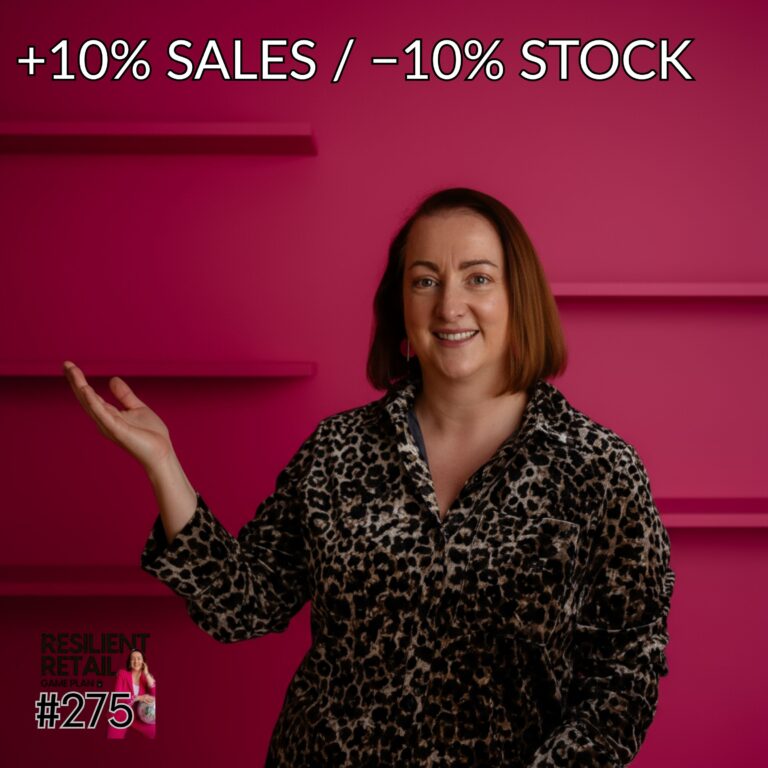
We’ve seen some incredible impact from this service. For example, we’ve seen on average over six months customers seeing a 10% growth in sales on 10% less stock, which is adding a real chunk to their cash flow to their bottom line and really helping this whole cash flow conundrum feel much better. So stock is like trapped cash. If your business is feeling stuck, if it’s feeling like there isn’t enough cash flowing through it, then your stock could well be a culprit. So there you have it. Shops, sales, having it all mapped out, overheads, profit and stock. And if you want to have it all mapped out, head over to resilientretailclub.com cashflow and get your hands on our free cash flow planner with an explainer video. So what’s next? Well, I would say if you just want a quick 2 minutes on how to improve your cash flow, start with a margin check, pick your five best sellers and calculate your in margin again.
Catherine Edley [00:17:52]:
If you want to know more, go listen to episode 259 where we talk more depth about margins and how to calculate them and then take a look at your stock levels. How much stock are you sitting on? If you look at your average weekly sales over the last 12 weeks, how many weeks worth of stock do you have in your business as well worth calculating and it can be quite eye opening. So use this shop’s framework to do a mini self audit and as I said, head over to resilientretailclub.com/cashflow to get yourself a free cash flow planner. So shops helps us focus what actually moves the needle in your business and make sure that you grab your free template. And why not head over to Instagram as well. Say hi at Resilient Retail Club. Let me know what you thought about today’s episode and ask me any questions you’ve got about your cash flow. See you next week.
 Skip to content