265_Stock_Planning_checklist
Catherine Edley [00:00:00]:
Do you know if you’ve got the right stock ready for peak season? Or could you be missing out on sales or even sitting on piles of unsold stock come January? Having a clear plan for your stock is the absolute backbone of a stress free quarter four. We are heading straight towards quarter four. And yes, it’s time to talk about Christmas, it’s time to talk about peak, and it’s time to talk about getting your stock planned out ready to go. What we’re going to be going through in this episode is a simple step by step checklist of what you need to think about ready for your peak season success. So this might be an episode where you want to grab a notebook because by the end you will have a clear plan of action to make sure that you are ready to go with your stock for the busiest sales period. So why does stock planning matter? I spent nearly two decades in big retailers, including some where Christmas was absolutely the make or break point of the year. And let me tell you, planning out our stock was half of the job. It was all about getting ready, getting prepared, making sure that we had the right stock at the right place at the right time.
Catherine Edley [00:01:13]:
And the reason for that is because stock and sales are completely intertwined. So if you are relying on Christmas to drive a big bulk of your sales this year, you’re going to want to make sure that your stock is going to support that. So stock equals cash. It’s as simple as that. Anytime you’re spending money on stock, then it is effectively tying it up. So the right stock strategy can help you free up cash and boost your profits. There are dangers galore in the peak season as well. There’s dangers of over buying, so tying up money and space versus under buying where you might be losing sales.
Catherine Edley [00:01:50]:
And the peak season amplifies both those risks. So it is well worth your time spending a few minutes thinking about what you want to do to drive your sales at Christmas and checking that you’ve got the right stock to support you. So, for example, I spoke to a client in January who had had an amazing start to their Christmas season, but because they hadn’t really recognized just how much their sales have been ramping up, they sold out well before the peak sales really kicked in and left money on the table. And every year I speak to people who have got themselves in a difficult situation on the other way around, that they’ve overbought for Christmas or they’ve overbought in that peak holiday period and therefore they’re ending up sitting on far more cash than they should in January. So what we’re going to do today is walk through some simple steps to try and get, get ahead of the Christmas rush and to give you that peace of mind that you are in a good position going into peak. And one of my favorite stories, if you’re thinking, well, I, I should know this stuff by now, one of my favorite stories is I worked with a client, they’re a fashion brand, and they came to me because actually they’d been to a Shopify event all about Black Friday Cyber Monday. And specifically what they wanted support with was how much stock they should have for this big event, which was a huge piece of their yearly sales that they were planning. And they talked all about getting ready for Cyber Monday, Black Friday, Cyber Monday.
Catherine Edley [00:03:20]:
And then afterwards, he went up to the person who presented and said, well, how do I actually work out how much stock I need to have? And the person said, oh, it’s really about your gut feel. You need to go with your gut. And for me, the reason that I love this story is because it tells me that these kind of things, this kind of information is really important, that there isn’t enough out there about how you actually work this stuff out. And secondly, it just goes to show that lots of people who maybe are pretty high up in the e commerce world, in the retail world, this is not an area that even they know about necessarily. If you’re ever thinking, how do I figure this out? How do I even do it? Then we’re going to unpack some of that today. So the first thing you want to do, nice and simple is, is you want to look at last year’s sales data. Now, it’s possible that you’re listening to this podcast and this is your first ever Christmas, in which case you’re going to have to skip this step. Although I would say, arguably I would have a look at what you’ve been selling so far because it’s going to give you some clues as to what your bestsellers are going to be at Christmas as well.
Catherine Edley [00:04:23]:
But let’s say that this is not your first Christmas, which I’m sure for a lot of you it won’t be. And so we’re going to start with a bit of a review. Now, my favorite thing to do in January, I do it every year inside the membership group Resilient Retail Club, is we have a lessons learned and strategy session which is all about recapping Christmas. And so we do it in January because we know that people forget and years gets busy and you think they’ll never forget what happened last Christmas, but you can easily. And so what we want to do here is, ideally you’d have done this in January, but bearing in mind that there’s the best time to plant a tree was 50 years ago. The second best time to plant a tree is today. So let’s go for it. We’re going to dive in and look at last year’s performance.
Catherine Edley [00:05:10]:
And the beauty is most reporting systems will just let you change the dates and look back and it should be pretty easy for you to get this information. So what we’re looking for here is what your best sellers were. We want to know what your best selling products were during the Christmas time period. And it’s up to you what you consider the Christmas time period. You might want to consider the months of November and December together. You might want to look at the whole fourth quarter October through to Christmas, it’s up to you. But during that Christmas selling period, however you define it, what sold best, Have a look at your best sellers and more importantly, how many of those did you sell? You’re looking for the 80% of sales products. So 20% of your products most likely are going to be generating 80% of your sales.
Catherine Edley [00:05:56]:
These are the ones you want to get right. So if you’ve got hundreds of products, don’t worry, just focus on your top sellers because that is going to be what makes or breaks it. So you’re going to want to know what, what your bestsellers were and how many you sold of them and then also have a look. What products did maybe don’t pop up on the bestseller list, but you know that as you scroll down the list and you look through, you think, oh, do you know what we sold out to that really early? Ironically, one of the things that happens, especially in independent retailers in bricks and mortar, is when you sell out of something, you no longer see it. So it can almost drop out of your mind. But just take a time to think through. Were there things that you bought and just went really quickly that you could have sold more of? And were there products that even if they sold quite well, had they declined year on year? Are you beginning to get the sense from your customer that they’re moving away? And most importantly, you want to take the lessons from this data. You don’t just want to look at this data just so that you know how that you sold 400 of the Star ornament in the month of November and December.
Catherine Edley [00:06:53]:
You want to really go through it and look and say what worked well, that I need to do more of. Okay, those, those ornaments were great. Can I bring more in? Okay. I equally had another type of decoration that usually was my bestseller but had dropped down. Okay, do I retire it? Do I replace slow movers? And where did I miss out? Where did I have products that I definitely could have sold more of? So once you’ve completed all of that analysis, then what I’d encourage you to do is identify your hero products. So your hero product does not have to be Christmassy. It doesn’t mean that you can’t make it a little bit more festive with some festive packaging or something like that, just for the Christmas time period. But when I talk about Christmas hero products because it has the word Christmas in or peak, then people tend to think, oh, does it have to be themed? The answer is absolutely not.
Catherine Edley [00:07:47]:
The most important thing is that it’s giftable. So what is your best selling giftable item year round and is that applicable for Christmas? Chances are probably yes. Chances are that’s probably going to be your hero product. Now you may want to have different hero products. You may have one which fits into the five to ten pound price point that’s great for stocking fillers. There’s the 20 to 30 pound gifting sweet spot, which is also really important at Christmas time. And then there’s also that 50 pound plus for special gifts. Now if you sell jewelry, for example, you may not have all of those different price points mapped out.
Catherine Edley [00:08:25]:
That’s absolutely fine. You still want to map out your hero product, the one that people are most likely to want to buy as a gift at Christmas. But equally so, if you are somebody who has lots of different products, you’re selling lots of different ranges from different brands, then you definitely want to pull out your hero products, not just one hero product, but across the price points. So why are hero products so important? Well, it just helps you keep organized, it helps you keep focused. You can make sure that you have at least some kind of photography that will help you sell it as a Christmasy item. You can focus. If you’re going to be doing PR outreach, for example, or trying to get into gift guides, then that’s what you focus on with your hero product. You want it on your homepage, you want it as part of your email campaigns, you want it in your social media, for example.
Catherine Edley [00:09:14]:
And picking those products now means that you become really focused and really clear as you’re going through the season rather than each week thinking, right, well, what do I talk about? What do I talk about now? So make sure you’ve got those HERO products mapped out. And the other thing that is useful about mapping out your product, your HERO products. So if we come on to step three is it also allows you to review your range and fill your gaps. So for example, you might be doing this exercise thinking, what do I really want to focus on? And then you suddenly realize, well, I really don’t think I’ve got any strong contenders for stocking fillers this year. Or actually everything that I’ve got is either under 10 pounds or over 50. I really don’t have anything in that 20 to 30 pound gifting sweet spot. So it can be a really useful exercise to help you think about what you might need to tweak. Are there any gaps that you need to bring in? Now, depending on how you source your product, this ship may have sailed.
Catherine Edley [00:10:12]:
You may not be able to get any new products in for the Christmas season, in which case you’re just going to have to think about how you can work your messaging to support the products you do have. But for lots of you, where maybe you’re designing your own products or, or perhaps you’re buying products in from other people, you are going to be able to make those last minute tweaks, have a look through, have a look at everything that you’ve got, pull out what you think your heroes are going to be. It’s also good, you don’t necessarily want to just talk about your heroes all the way through the long Christmas promotional period. So you may want to pick up, pick out some alternates as well in each category. But then just have a look and think, am I missing anything? Again, if you’re somebody who is a lifestyle store, for example, a gifting store, have you covered off almost, think about what marketing messages you might want to send out during that time period and if you’ve got the product for it. So you might want to do gifts for her, you might want to do gifts by interest. So for gardeners or for bikers or wild swimmers, you might want to think about hostess gifts and Christmas party earrings and Christmas Day jewelry and think about all the different messages and then just think, do I have the product to support that. It’s much easier to do this now before you get into the busy time period than to arrive in November and December and think, oh, I wish I could do a gift guide for under 10 pound gifts, but I’ve really just got this one item.
Catherine Edley [00:11:35]:
So really look strategically at your range at this point and if you are able to make changes, then have A look and think about where you can fill in the gaps because it will make life so much easier for you as you move through throughout the season. So step four is set your launch dates. So this is something that comes up a lot. When do you launch Christmas? And it depends. It’s what you’re used to in your business, what’s worked for you in the past. But I would say very broadly speaking, you can have a soft launch. In other words, put it out in store without making a fanfare about it, or put it up on your website, maybe even in September or October. But then generally speaking, the point in which we can all agree that it all becomes Christmas, all consuming, all Christmas, or as one of my clients once called it, screaming Christmas, is post Bonfire Night.
Catherine Edley [00:12:30]:
So we get through Halloween, we get through Bonfire Night, and then pretty much it switches over and we’re talking about Christmas. So most people will do their full Christmas launch that will be coming up at the beginning of November. So have a think about when you want to talk about it. Have a think about things like when your emails will go out to talk about it, when do you need to have photo shoots done ready for those emails, when do you want to pitch to pr, if that’s something that you’re going to be doing. And then you can work backwards from your chosen launch date to make sure that you map out your content and you map out your promotions. Once you set your dates, then that helps you work backwards from that, making sure that you’ve done everything you need ready to go for your launch. So you can even map out when you’re going to create your content. You could do it ahead of time.
Catherine Edley [00:13:23]:
Why not do it in September? It’s a much better month to try and prep all of your Christmas marketing, for example, than trying to do it all in the peak time period. So pick your dates and then also pick, like when do you think are going to be the peak selling periods for these products? Because that brings us on to step five, which is all about forecasting your sales. So you’ve looked at last year, what you sold, you’ve looked at this year, what you’re building, all of your ranges around, you’ve identified. If there’s any gaps, you filled those in. Now it’s time for you to think about what you believe that you are actually going to sell. So how do you do that? Well, again, if this is your first Christmas, it may be a little bit tricky, but I would just say, say have a think about what kind of an uplift you might Expect. Do you think that if you sell 10 of something in an average week, maybe assume that you will sell double that in November and December. As long as you have logical assumptions, you’re going to be able to tweak and refine it so that in future years you will have better information.
Catherine Edley [00:14:25]:
But for this year, you are just going to have to go with an educated guess, something that seems logical, that you’ve worked through. But ultimately, until you get into a Christmas season and see how it reacts for you, you won’t necessarily know. So for everybody else you can use historical sales data. So if you believe that your number one item is going to be the lavender candle this year, last year you sold a hundred lavender candles, but this year so far your sales are pretty much double what they’ve been to this point last year, then you could say, right, well I think I’m going to sell about 200 lavender candles. Then you could say, well, I think I’m going to sell about 200 lavender candles this year. So for example, you’re just taking a combination of your current sales performance and your last year’s sales performance, putting them together and coming up with an estimate. So that is what you call your run rate. So your run rate is how you’re currently performing against last year.
Catherine Edley [00:15:21]:
So if your sales are double what they were last year to this point, then you can, you could assume, you could take an educated guess that your Christmas sales are going to be double. For example, you can also go through and if you think actually that feels really punchy. I don’t like the idea of planning my Christmas sales at double, then sure, by all means, be really conservative. I’m quite often conservative when I’m planning out one to one clients and looking at their Christmas sales. I tend to slightly under plan just because sometimes you just can’t physically process twice as many products as last year. So you need to be a little mindful of what’s actually going to be going on in the business. Do you think that you’re going to hit those numbers? And if it feels too scary and too like you could have to over commit to stock in order to hit those numbers, maybe pull it back slightly on the basis that it’s better to under promise and over deliver than to set yourself really crazy big targets and then be disappointed if you don’t hit them. So if it’s a new product again, you could have a look at and say my best selling item usually sells about 50 a week during the Christmas period and we’ve got eight weeks of promotion.
Catherine Edley [00:16:32]:
So I think that’s going to be about 400 units because I think this new product is going to be one of my best sellers. That’s why I’ve chosen it as my hero product. So for each one you want to go through and logically look at, for your, each one of your hero products you want to logically go through, look at what did I sell last year? Either this product or an equivalent product. What’s my uplift? I think for this year, therefore, what do I think I’m going to be generating? And again, it is an estimate, right? So you’re, you don’t know for sure the all sorts of different things that can happen. It can also actually help you to work out when you do this exercise to kind of go through and go, well, hang on a minute, if I was selling 200 of those a day, can I even physically dispatch that? Again, any work that you can do to check through those assumptions now, as opposed to waking up in November and realizing that you’ve got a capacity issue, anything that you can do now is super, super helpful. So do think through what this actually means. If you’re planning double the sales of last year, just think to yourself, now, can I physically do that? Who do I need to bring in? Do I need more space? Do I need more resources? That’s, that’s a whole other piece of work. But then when you’re looking at the individual product lines, then always ask yourself this very, very important question when it comes to your Christmas purchasing.
Catherine Edley [00:17:51]:
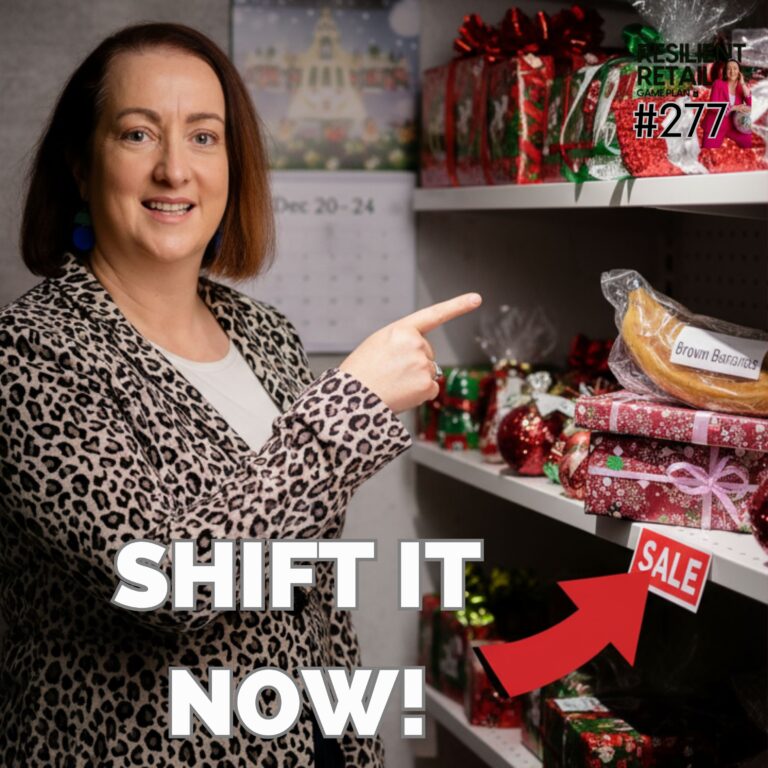
Which is worse, having too much or not enough? And ask yourself that for every single product that you’re ordering ready for Christmas. And there’s two different ways of looking at this. Some products are Christmas specific. They are what I like to call brown bananas, which means that on the 26th of December, nobody’s going to want to touch them. So that’s anything that says Merry Christmas, that’s an Advent calendar after we’ve got past about 3rd December. It’s anything that’s got a really clear cutoff. Those products, generally speaking, if you ask yourself that question, which is worth having too much or not having enough, the answer is going to be having too much. Because if you’re left with it, you can’t do anything with it for a whole year.
Catherine Edley [00:18:35]:
You’re just going to have to sit on that stock, which is basically cash tied up in your business for an entire year. So those are the products that you, generally speaking, want to under buy. You want to be out of stock of those really before Christmas so that you’re not left either having to mark them down significantly in a clearance sale to get rid of them or sit on them for a whole year, store them somewhere and bring them back out for Christmas. So those types of products, generally speaking, the question which is worse, having too much or not enough? The answer is going to be it’s going to be worse for me to have too much. So therefore when you’re planning out your quantities, you’re going to bring those quantities down, you’re going to be a bit more conservative. Now, your year round bestsellers going back to this lavender candle, the question which is worse, having too much or not enough? Well, actually if I’ve got too much, I’m just gonna have more in January. I won’t have to place an order in January, that’s actually absolutely fine. But if I run out of my key bestseller halfway through the season, that’s gonna be a real pain for me.
Catherine Edley [00:19:34]:
That’s gonna mean that all of the effort that I’m putting into these ads, into these campaigns, everything that I’ve got lined up, that’s all going to be for nothing. So therefore, that is an item where when you do your analysis, maybe you add a buffer on you do right. I think I’m probably going to sell 200, but you know what, I’m going to buy 250 because it’s worse for me if I have not enough. So for every single product you go through, ask yourself that question which is worse, having too much or not enough? And then using that, adjust your forecasts accordingly. So either bump it up a little bit to make sure that you don’t run out or pull it back so that you’re not going to be left sitting on extra stock. So once you have done all of those things, then final step, step six is to double check all of your orders and your supplier lead times now. So if you are somebody who hand makes your product, then you want to prep all of your components early. Lots of people I know actually work throughout the summer to get their Christmas stock ready.
Catherine Edley [00:20:35]:
So obviously that’s a little late now, but do have a look and see what you can do to make sure that you’ve done your work ahead of time. If you’re like most retailers, this will be a tricky time to be bringing an intake. I know for a fact that there’s a real cash flow pinch point at this time of year in September, October if you are a retailer. Lots of people I know get around it by using things like FAIR and their payment terms. To help push the payment back further. So I do appreciate that it’s a tricky time of year, but if at all possible you, if you’ve got products that you know are going to be a really important time, really important part of your Christmas marketing and now is the time to bring them in. So this is your little checklist for you to go through. So number one, review last year’s performance.
Catherine Edley [00:21:23]:
Number two, identify your hero products. Number three, fill in any price point gaps or any gaps in the range that you feel might need to be attended to. Number four, plan out your launch dates for Christmas. Number five, forecast your sales by line and ask yourself that all important question, which is more important, which is worse, having too much or not having enough? And then make sure that you put in a plan and you secure and prepare your stocks that you are going to have the stock in time for Christmas. And if you’re listening to this thinking this sounds great but I just don’t have time for any of this, then I would love for you to check out the stock doctor service. It’s at resilient retail club.com stockdoctor and we have a done for you service where trained retail professionals will come in and help you get ready for your best Christmas yet. Thank you so much for listening and I’ll see you next week.
 Skip to content