Catherine Edley [00:00:00]:
Have you ever had a record breaking month followed by total silence? You’re not alone. If your sales feel like a rollercoaster with highs and then worrying lows, then this episode will help you understand why it happens and what you can do to finally break the cycle. Welcome to the Resilient Retail Game Plan. I’m Catherine Edley and in the next few minutes, you’re about to get powerful real world retail strategies from insights shared both from my guests and myself, backed up by my 25 years in the retail industry. Keep listening to learn how to grow a thriving, profitable product business. Let’s jump in with this latest episode. A few weeks ago I was having a chat with a lovely founder. She just had her best month ever.
Catherine Edley [00:00:46]:
Absolutely flying. She had a new product launch, she had lots of interest and lots of sales. But then two weeks later, later she had crickets, nothing. Sales dried up almost overnight. And even though she knew she hadn’t done anything wrong, and she certainly wasn’t doing anything different than she had been when things had been working well, then the self doubt really started to creep in. She said to me, I thought I’d cracked it. I thought I’d finally figured out what my customer wanted. I thought I’d finally started to get that momentum going and now I feel like I’ve lost my momentum and I don’t know how to get it back.
Catherine Edley [00:01:23]:
And then that’s the thing about fluctuating sales. It’s not just about cash flow. It can really knock your confidence and you start questioning everything. Was it a fluke? Am I doing something wrong? And probably the number one question that crosses people’s minds when sales are slow, which is will the sales ever pick back up? Let’s talk about why this sort of thing happens. So why do people have sales spikes followed by lulz? The reality is, is that most retail is extremely variable and you are seeing it more because the likelihood is that your volumes aren’t huge yet. So the slightest variation in sales can really feel like a very big variation. And I’ve worked for many retailers for many years and I’ve worked with many clients. And even in the big retailers, even in the ones that were turning over a couple of billion dollars in sales every year, there would be quiet days and there would be busy days.
Catherine Edley [00:02:27]:
For example, when I worked in the US I was managing a chain of over 550 stores. Then one store would have a quiet day, but another store would have a busy day. And between the two of them, it would even out. So first of all, just to Say that a certain degree of fluctuations are completely normal. Sometimes we see a bit of a dip in the middle of the month or getting towards payday. Payday does still have an impact. Not as big as it used to be, but it does still happen. Basically, there isn’t a certain element to which you’re going to see things shifting day to day, week to week.
Catherine Edley [00:03:02]:
And the lower your sales overall, the more it’s going to feel like a big fluctuation. Because if two sales is really big for you, then you can imagine that a day where you sell two versus a day we sell zero is going to feel very, very different. Putting aside for a moment the fact that a lot of the time in retail it just does fluctuate and you don’t always know why. Often what we see is it starts with a spike. When I was talking to people, for example, the founder, who’d had their best month ever, and then crickets, what actually happened was they launched something new. They were super excited about it. It was something that they found they really wanted to get onto their social media, talk to their customers about it. They just felt very energized and really enthusiastic, and therefore they were naturally showing up and connecting with their audience.
Catherine Edley [00:03:53]:
And often when people see these spikes, these peaks and troughs, then the reality is either it was just a very busy time of year, for example, it was Christmas, or maybe they were doing some kind of stock clearance event or deal, so that was getting people to buy. Or maybe they had a launch that they felt really excited about and then naturally were overcoming what many, many people have, which is a natural aversion to actively selling. So they had something that meant that there was sales. But then things got busy. They’re fulfilling orders, they’re juggling everything else, and they didn’t have a plan in place to keep the momentum going. So once that kind of natural burst of activity happened and was over, there wasn’t anything to help keep them going. So their energy fizzled out because they were doing it all on a very ad hoc basis. And once the energy fizzles out and maybe the sales start to dip, then if that confidence wobble comes in, then it can create this vicious cycle, or the cycle of doom.
Catherine Edley [00:04:57]:
I often refer to it the cycle of doom, where confidence drops so you’re taking less action, so your sales go down, so your confidence drops so you take less action, and so on and so forth. The cycle then maybe will start again. When you feel excited about something, something, or you have a launch, or again, it’s your Peak time of year, maybe Christmas for a lot of people will be their peak time of year. Or back to school could be another one. Or January if you’re in the fitness business or you have anything to do with weddings, because often wedding interest peaks in January. It can then mean that you’re not only feeling less confident, but in a way, because you’ve been through this cycle, it can leave you feeling very confused as to why was it working and why is it not working now. So the feast and famine, as I said, it can be something that can be really, really exhausting for a lot of people and really difficult. So what are some signs that you might be stuck in the feast or famine cycle? So the first sign I’d say is that sales really follows your energy.
Catherine Edley [00:06:06]:
So what I mean by that is, is that if you are showing up when you’ve got something new or exciting that you’re really fired up to talk about and people respond to it, but when you don’t know what to say, you disappear. That is a really big warning sign for me when I’m talking to founders to say, okay, there’s something going on here. If you’re allowing yourself to effectively be governed by your energy level, as it were, when it comes to your sales. So when it’s exciting, when you’ve got something to talk about, you’re showing up and you are selling. Or maybe again, it’s your peak time of year and therefore sales maybe feel a little bit easier, then you’re showing up. But when you don’t know what to say, then all of a sudden your energy fizzles out. The second sign that you’re stuck in a feast or famine cycle is that your marketing is reactive. So you wake up, decide what to post on that day.
Catherine Edley [00:07:04]:
It’s not part of a bigger picture. And probably if I asked you what your overall marketing strategy was, then you would be pushed to say you. Maybe it’s like, okay, well, I know I need to talk about this, but I don’t really know how all of the pieces connect together. And I am basically just deciding week on week, what do I feel like talking about today. And then the third sign, or the third kind of red flag, if you like, for being stuck in feast or famine cycles, is that you’re not taking advantage of seasonal cycles. So what I mean by that is, is that it’s very important for you as a business owner to not only understand your customer, not only to think about what they want in general, to really have a good understanding of what that customer wants. But you really need to be thinking about what does your customer want right now. And that’s because ultimately, at the end of the day, retail is a game of probability.
Catherine Edley [00:08:05]:
It’s about you talking about the things that your customer is most likely to want from you at this particular point. So if it is October and the nights are drawing in and it’s getting colder, what is your customer most likely going to want from you? Well, they’re most likely to want things that relate to the changing season. So they may want things that will help them stay warm. They may want things that will make their house feel cozy and warm. They may well want things that are to do with Christmas because they’re super organized or they’re on a very tight budget and they want to spread their Christmas spending across the a few months as opposed to doing it all in one go. They might be thinking about Halloween. They might be thinking about making their home feel more autumnal, seasonal decorating. They may be thinking about updating their wardrobe with something that is appropriate for the winter season, getting their knitwear out and assessing if they’ve got everything they need to get them through the winter.
Catherine Edley [00:09:10]:
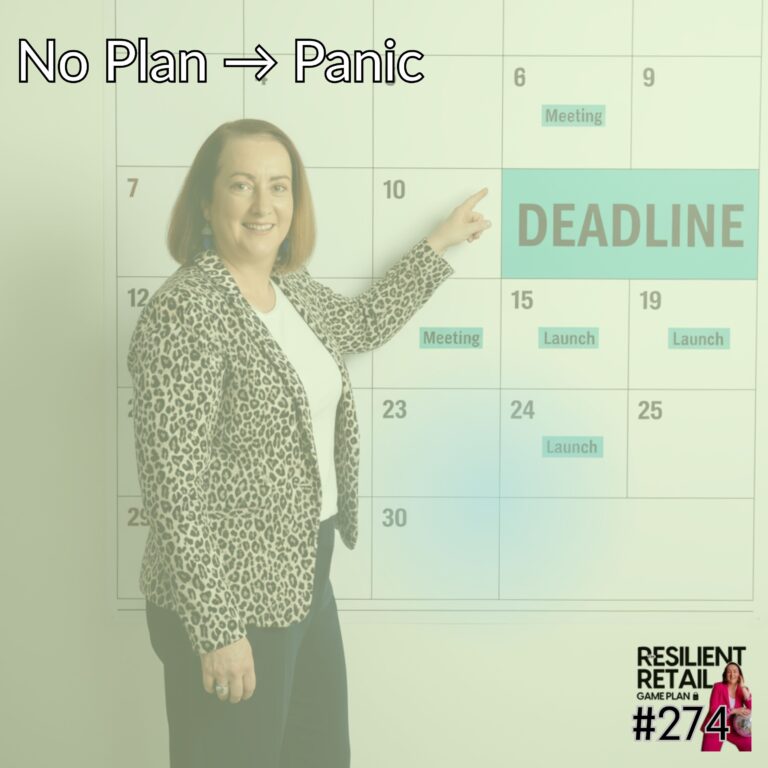
If you sell equipment or outdoor sports, then your customer is going to be thinking about what do they need as the weather gets colder that they maybe don’t have or maybe had last year, but needs replacing? For me, one of the red flags is when people just aren’t factoring all of this into their forward planning. Maybe they’re waking up in October and thinking, oh, maybe I should talk about my cold weather accessories, for example. But they’re not getting it planned out in advance. Retail, as I’ve said before, it does fluctuate a lot, but it also does repeat year on year. So it’s really important to get that plan into place. So let’s flip this and look at it from a different perspective. What does actually create consistent sales? And the thing is that it’s about creating a system. It’s not about pushing harder or constantly launching.
Catherine Edley [00:10:08]:
It’s about building a sales system that can operate whether or not you’re in the middle of a launch or whether or not you’ve come out of the launch. And it includes things like it’s about building a sales system that can operate whether or not you’re in the middle of a launch or whether or not you’ve come out of the launch. And it includes things like planning your sales calendar in advance, tying together your product launches and your marketing messages so that the two are working together, having a really clear Idea about what conversation you want to have every single week with your customer as you move through the year, knowing what your best sellers are and helping you focus your marketing there, Making sure that you can consistently talk to your customer across all touch points. And one of the best ways to do that is via email. So making sure that you’re building and actually using your email list. And this is really important, creating a rhythm that doesn’t rely on your energy or your mood. So what do I mean by that? Well, at the moment, an example I can give you, unrelated to retail, but relevant here, I feel, is that I’m currently training for the Valencia Marathon in December. I have got a plan.
Catherine Edley [00:11:28]:
I have a training plan. And what that means is that I know in a particular week what I need to run in order to work towards my larger goal. Does that mean that I don’t wake up some mornings, maybe many mornings, and think, ah, I’d really rather not run today? No, absolutely not. There are definitely days where I wake up, especially now it’s darker in the morning, and I think, oh, you know what I really could do with giving this a miss. But I’ve got a plan. So I am able to say, right, the most important thing is I stick to the plan. I’m letting go of the outcome, but I’ve got a plan and I just have to execute on the plan. It’s not about my motivation, it’s not about the mood that I’m in when I wake up.
Catherine Edley [00:12:14]:
It’s about me knowing that I’ve got a plan, I’ve got a series of things I need to do and that that is working towards this bigger goal and it’s effectively removing the mental friction so I don’t wake up and think to myself, I wonder how far I should run today. I wonder what would be the best thing for me to do. Because that is often for many of us, where the block comes in. Because as soon as we’re able to sort of say, oh, well, I don’t really know what I’m doing, not really sure, then we almost immediately are able to talk ourselves out of doing something thing. Whereas I know I’m gonna wake up and I have to run 13km and this is the paces that I’m aiming for. Whether or not I hit them is another question. But this is what I’m aiming for, then I know that I just have to get up, get out and do it. And having a sales plan can be like that as well.
Catherine Edley [00:13:04]:
Because many people, as I mentioned earlier, it’s not something that is their natural wheelhouse. They don’t naturally wake up every day and think, I know what I want to do, I want to sell my products. Most people, they love the creative side of their business, they love selecting the products, they love talking to their customers, they love the whole idea of having the product business. Whether or not they love the actual selling is another question. But if you’ve got a plan, if you’ve got a plan mapped out for you of what you’re going to talk about, it removes that mental friction. It stops you waking up and wondering what on earth you’re supposed to do that day and then wandering off and doing something, something else. Because we naturally gravitate towards the tasks that we find the easiest in our business. 100%.
Catherine Edley [00:13:51]:
I see it time and time again. Whatever you enjoy the most, you will naturally gravitate towards. If you don’t have a plan, if you’re relying on energy or inspiration, the chances are you’ll only show up when you’re really excited and then you’ll go quiet again when you either get busy or the launch has passed, or the peak season’s past. And then you don’t really know what to do. Say so. Then the momentum dies and the confidence takes a hit. But when you’ve got a system that supports you, one that’s really sustainable, simple, repeatable, then everything starts to feel calmer. You show up more, you start to build trust with your customers and then you can start to look at the different ways of growing sales and the sales start to smooth out.
Catherine Edley [00:14:29]:
So if you want to know more about the different ways to grow your sales in your product business, do go check out episode number 264 of the podcast, which is called Four Ways to Grow your sales, where I go into more detail into the different ways that you can grow. But just know that if you have a plan, then you’re able to really work on all four of those elements and then that helps you grow your sales overall. As I said, build that momentum and grow your trust with your customers. So if you are sitting here thinking this sounds awfully familiar, I’m pretty sure that I am scattergun with my approach. Maybe you are noticing that you’re in the feast and famine, then I definitely recommend checking out the retail sales game plan. It is my brand new 16 week program designed just for product business owners like you. And right now we have the wait list open. So if you head to resilient retail club.com waitlist, you’ll get £50 off when the doors open plus early access and some juicy bonuses as well.
Catherine Edley [00:15:38]:
So if you are listening and thinking, yes, I really need someone to walk me through this process, putting together a plan, looking at my business, looking at the different ways of growing my sales, how to make it smoother and more consistent. Then you definitely want to head over to resilient retail club.com waitlist and get on the list for the retail sales sales game plan. We will be kicking off in early November. We will get you sorted out right away for your Christmas plans and then we will be together until the end of February in 2026 and we’ll have time to work together on putting together that plan for the whole of 2026, planning that out and giving you a really great start and a way to make your sales more calm and consistent. Because that’s what we want. We want to get off the roller coaster and into the driver’s seat. We want to go from feast and famine to calm and repeatable sales. Thank you so much for listening to the podcast.
Catherine Edley [00:16:37]:
If this today’s episode has hit home, feel free to share it with a friend who you think would benefit. Or why not tag me over on Instagram at Resilient Retail Club. I love to see where people are listening in when they’re listening to the podcast. And as always, I’ll see you next time week.Overcome_Feast_or_Famine_Cycles_audio
 Skip to content